Introduction
Picture this: You’re at a reenactment. The crowd is watching. Someone snaps a photo. Then a fellow collector leans in and says, “That’s not the right wool weight for 1940.” It stings. If you care about history, you want your kit right. But sourcing accurate Uniforms of the British Army from the Crimean War to WWII is not easy. Specs change. Small details matter. One wrong braid, one wrong pocket angle, and your display falls flat.
The problem? Many replicas skip historical specs. The agitate part? You spend good money and still fail inspection at events. The solution? Buy from a supplier that follows records. At paddelaters.com, you’ll find Crimean War British infantry uniforms and WWII British Army battledress made to period standards. Think bell-top shakos with correct 24-line cords. Think Pattern 37 wool serge at 18 oz per square yard. You want facts. You want details. Let’s break it down.
Crimean War British Infantry Uniforms
Start with the 1850s. The Crimean War (1853–1856) exposed supply and uniform issues for British troops. Infantry wore scarlet coatees made of wool broadcloth. Trousers were dark blue with red welt stripes for line regiments. Headgear included the bell-top shako earlier in the period and later the Albert shako introduced in 1844 but still seen in Crimea. Period records note 24-line cords on certain shako patterns, with brass front plates and regimental numbers.
The coatee had tight skirts and shoulder wings for flank companies. Fusiliers and grenadiers had distinct lace patterns. Belts were pipe-clayed white buff leather. Weight mattered. Wool broadcloth was heavy, built for European winters but rough in the Crimea’s mixed climate.
Why does this matter to you? Because reenactment judges check lace width. They check button spacing. Buttons often bore regimental numbers or the royal cipher. Using generic brass buttons is a fast way to fail inspection. Accurate Crimean War British infantry uniforms follow War Office clothing regulations of the era. That’s the level you should expect.
WWII British Army Battledress Breakdown
Jump ahead to 1937. The British Army introduced the Battledress, Serge. It replaced earlier service dress for field use. By WWII, the standard issue was Pattern 1937. The blouse was short, waist-length, with concealed buttons. Two pleated chest pockets. Trousers were high-waisted with a large map pocket on the left thigh and a field dressing pocket on the right front.
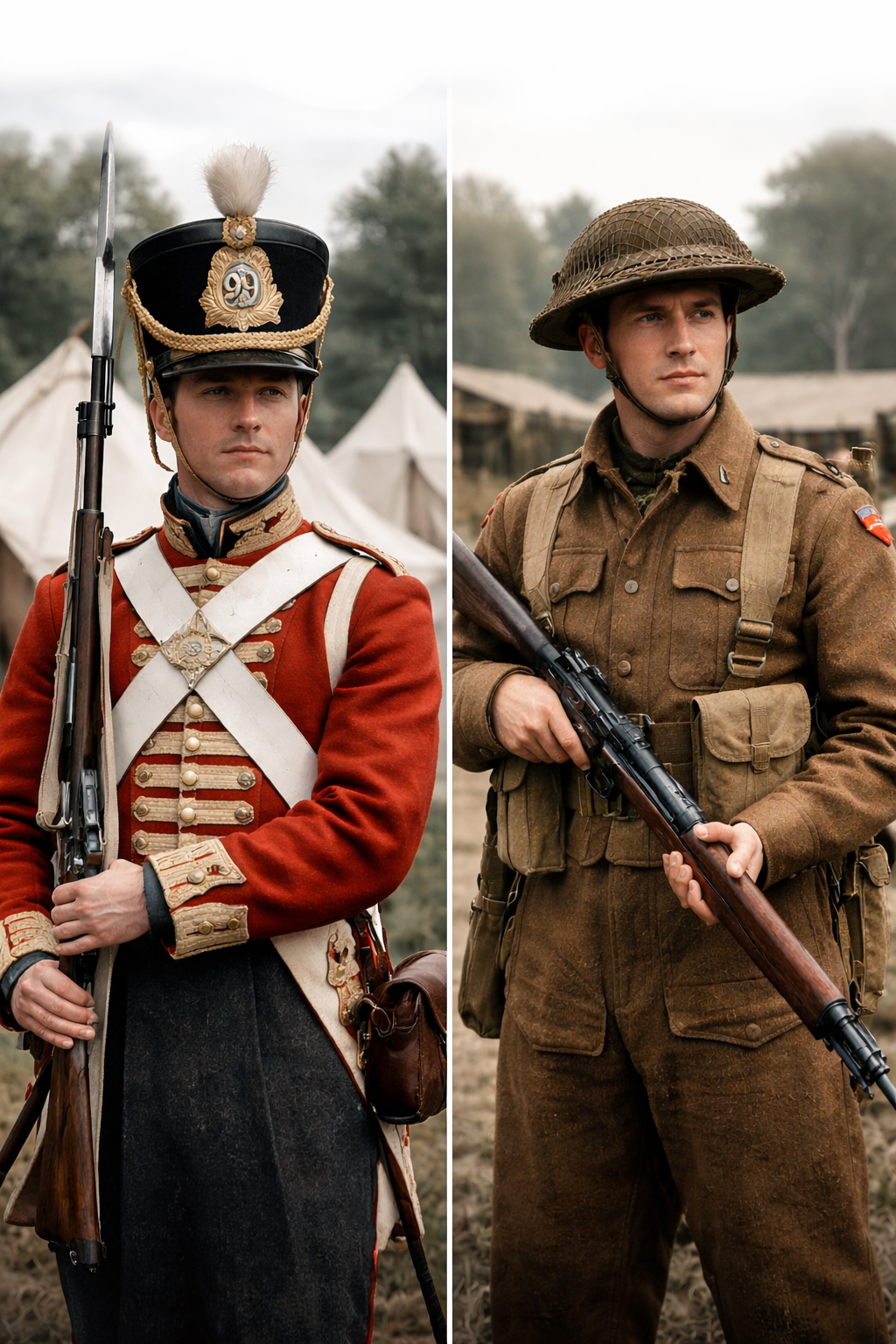
Fabric spec? Wool serge around 18 oz per square yard. That weight gave warmth and durability. Color? Early war khaki brown, shifting tones depending on dye batches. Labels inside often listed contract numbers and year.
Webbing was also Pattern 1937. Blanco was used to color the web equipment. Add the British Army stable belt for later parade or barracks wear. Rank insignia varied by arm of service. Infantry divisions had specific formation patches sewn high on the sleeve.
For a reenactor, the small details matter. Pocket angle. Button type. Proper serge weight. A lightweight modern wool blend just doesn’t hang the same way. When you’re building a full WWII British Army battledress impression, you need accurate cut and cloth.
Key Features and Materials
Let’s get practical. What should you check before buying?
First, fabric weight. Crimean era wool broadcloth should feel dense and structured. WWII battledress should use wool serge near 18 oz/yd². Too light and it drapes wrong.
Second, stitching and construction. Period uniforms used reinforced seams. On battledress trousers, the map pocket had a defined box pleat. Buttons were often stamped brass or steel, not shiny modern copies.
Third, lace and braid. Crimean War coatees used specific lace widths measured in lines. A 24-line cord equals roughly two inches in old tailoring measure. That’s not random trim from a craft store.
Fourth, color accuracy. Scarlet should lean toward the period dye tone, not bright modern red. WWII battledress should avoid greenish modern shades unless you’re portraying late-war variations.
At paddelaters.com, product pages detail fabric specs and pattern references. For example, see their WWII battledress set at https://paddelaters.com/products/wwii-british-army-battledress-set and their scarlet coatee replica at https://paddelaters.com/products/crimean-war-british-infantry-coatee. They also stock accessories like the https://paddelaters.com/products/british-army-stable-belt to complete your display.
When you read those pages, look for mention of period patterns and wool weights. That transparency saves you guesswork.
Pros & Cons for Reenactors/Collectors
Let’s be honest. Going accurate has ups and downs.
Pros:
You pass inspections. Event organizers often check uniform standards. Accurate Uniforms of the British Army help you avoid rejection.
You look right in photos. Heavy wool broadcloth and serge hang correctly. The silhouette matches period images.
You protect your investment. A proper WWII British Army battledress can last years of events if cared for.
You build credibility. Other collectors notice details.
Cons:
Cost. Authentic materials cost more than thin costume fabric.
Weight. An 18 oz wool serge blouse is not light. Crimean broadcloth can feel heavy in summer events.
Maintenance. Wool needs brushing and careful storage. Not everyone enjoys that.
But ask yourself: Would you rather save a little and feel unsure every event? Or invest once and stand confident?
Real-World Example: Reenactor Case Study
Let’s talk about Tom, a UK-based reenactor focused on 1944 Normandy impressions. He bought a generic battledress online. The fabric felt thin. At his first event, another member pointed out the blouse length was too long and the pockets were off.
Tom checked wartime photos and War Office specs. He learned Pattern 37 battledress used thick wool serge around 18 oz per yard. His set was closer to 12 oz modern wool blend. Wrong drape. Wrong look.
He ordered a replacement from paddelaters.com, choosing their WWII British Army battledress set. The product description listed correct serge weight and Pattern 37 cut. When it arrived, he noticed the difference right away. The blouse sat at the waist. The map pocket matched reference photos.
At the next event, inspection passed without issue. Photos from the weekend showed a clean silhouette. No comments about fabric. Tom later added a proper British Army stable belt from the same store to complete his barracks display.
He told fellow members the key change was simple: follow historical specs. That’s the difference between costume and kit.
FAQs
What fabric was used in WWII British Army battledress?
Wool serge, commonly around 18 oz per square yard for durability and warmth.
Did Crimean War infantry really wear scarlet in combat?
Yes, early in the war scarlet coatees were standard, though campaign conditions led to adaptations.
What is Pattern 37?
Pattern 1937 refers to both battledress uniform and web equipment introduced before WWII.
How do I check if my replica is accurate?
Compare fabric weight, pocket placement, button type, and cut against period regulations and photos.
Is heavy wool uncomfortable?
It can be warm, but it matches historical reality and improves authenticity.
Does paddelaters.com provide full sets?
Yes, they offer full uniform sets and separate items like coatees, battledress, and belts.
Conclusion
If you care about history, details matter. From bell-top shakos with 24-line cords to WWII British Army battledress in 18 oz wool serge, accuracy builds confidence. You avoid bad buys. You pass inspections. You stand in the field knowing your kit reflects real records.
So next time you prepare for an event, ask yourself: Are you wearing a costume, or are you wearing history? Browse paddelaters.com and explore their range of Uniforms of the British Army. Build your Crimean War British infantry uniforms properly. Upgrade your WWII British Army battledress with correct materials. Get it right the first time.
