BRITISH WW2 UNIFORMS: DESIGN CHANGES SHAPED BY WAR
Introduction
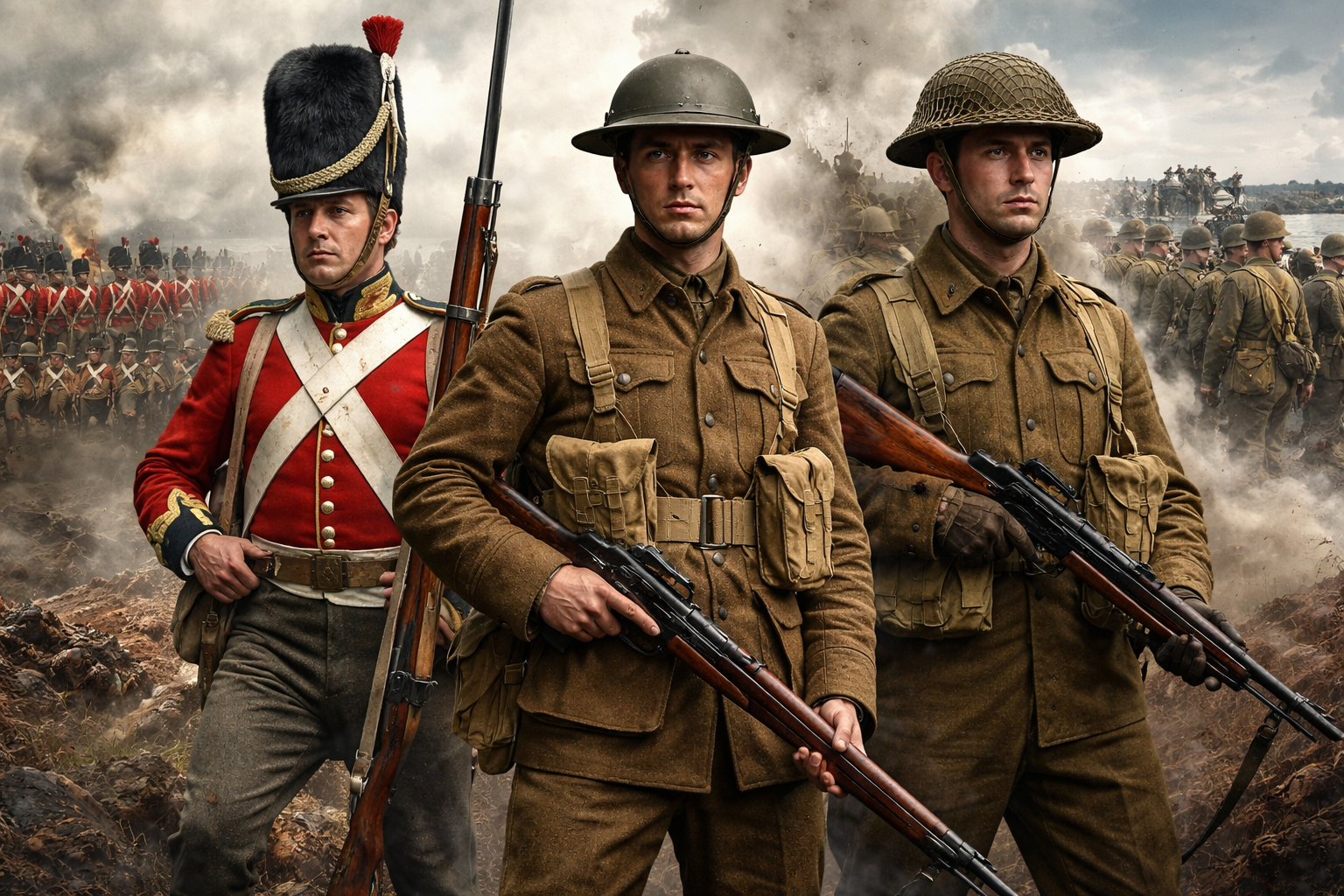
Imagine standing in a bright red coat on a battlefield where rifles can hit you from hundreds of yards away. That was normal for British soldiers in the 1800s. Uniforms looked sharp, but war was changing. Rifled muskets, machine guns, and artillery made visibility dangerous. Heavy wool trapped water. Poor supply systems left men cold and sick.
That is the core problem. British uniforms often looked good but did not match real battlefield needs.
The problem grew worse in World War 1. Trenches filled with mud. Rain soaked thick wool tunics. Shell fragments rained down. The army had to react fast.
By World War 2, things changed. The British Army moved to shorter jackets, better webbing, and mass production on a huge scale. The 1937 Pattern Battle Dress became the standard look of the British soldier.
Let’s walk through how that evolution happened.
Uniforms in the 1800s: Early Challenges
In the early 19th century, British soldiers wore the famous redcoat. The bright red wool coat was easy to see. That was useful for command and control in smoke-filled battles using muskets. But as rifles improved, that same red coat became a target.
The wool was thick and strong. It worked in cold weather. But it was heavy. When wet, it became even heavier. Soldiers also wore tight tunics and heavy equipment straps. Comfort was not the main goal.
Crimean War Case Study
During the Crimean War (1853–1856), British troops faced harsh winters and poor supply lines. Reports collected later by the UK National Archives show serious shortages of proper winter clothing. Many soldiers suffered from frostbite and illness.
The red coat was still in use. It was not suited for muddy siege conditions around Sevastopol. The war exposed big gaps in logistics and clothing design. According to official British records, disease killed more soldiers than combat in that campaign.
This conflict pushed the army to rethink clothing and supply systems. It was slow, but change had started.
By the time of the Second Boer War (1899–1902), the British Army shifted to khaki. Khaki drill uniforms were first used widely in India. In South Africa, they reduced visibility against the landscape. Modern Mauser rifles used by Boer fighters made camouflage necessary. The bright red coat was no longer practical in modern war.
World War 1 Uniforms: Trench Warfare Lessons
By 1914, the British Army wore the 1902 Pattern Service Dress. This uniform was khaki brown. It included a wool serge tunic with four pockets, matching trousers, puttees wrapped around the lower legs, and leather boots.
This was a clear improvement over red coats. But trench warfare created new problems. Soldiers lived in waterlogged trenches for weeks. Mud soaked into everything.
Somme Battle Example
At the Battle of the Somme in 1916, over one million men were wounded or killed on all sides. British troops advanced across open ground under machine-gun fire. The uniform did not cause the losses, but it shows the conditions soldiers faced.
Wool serge tunics became heavy when wet. Greatcoats were thick and warm, but in summer they were hard to carry. Equipment straps cut into shoulders during long marches.
Letters preserved by the Imperial War Museum describe constant dampness and lice in clothing. Soldiers tried to dry uniforms over small fires when possible.
Fabric and Equipment Stats
The 1902 Service Dress was made of wool serge weighing around 18 to 20 ounces per yard. It was strong and warm but not waterproof.
In 1915, the British introduced the Brodie steel helmet. By 1918, more than 7.5 million had been produced in Britain. It reduced deaths from shell fragments, especially from overhead bursts.
Uniform production numbers were massive. UK government records show millions of sets issued between 1914 and 1918. The scale of war forced factories to standardize sizes and patterns.
Still, trench warfare proved that long tunics and heavy coats were not ideal for fast movement.
British WW2 Uniforms: Key Features and Evolution
By 1937, the British Army introduced a new standard: the 1937 Pattern Battle Dress. This marked a clear break from the longer WW1 tunic.
The jacket was short and close-fitting. Trousers were high-waisted. Soldiers wore webbing equipment over it, known as the 1937 Pattern Web Equipment. This webbing carried ammunition, water, and tools in a balanced way.
The goal was mobility. Modern war would not only be trench warfare. It would include tanks, trucks, and aircraft.
Battle Dress: Pros and Cons
Pros:
-
Short jacket improved movement.
-
Wool serge was durable and warm.
-
Webbing distributed weight better than older leather gear.
-
Easy to mass-produce.
Cons:
-
Wool was still hot in summer.
-
Not waterproof without added layers.
-
Limited pocket space compared to later designs.
The Battle Dress was used in Europe, North Africa, and later in Asia. Troops in hot climates often switched to lighter khaki drill uniforms.
Production Facts
According to wartime British government supply records held by the UK National Archives, millions of battledress sets were produced between 1939 and 1945. Exact totals vary by contract, but the numbers ran into several million units to equip the British Army and Commonwealth forces.
The scale was huge. Britain had mobilized over 5 million men and women by the end of the war. Uniform supply became a major industrial effort. Factories across the UK produced wool cloth, stitched jackets, and assembled webbing.
The Imperial War Museum collections show variations of battledress with changes in pocket design and rank badges over the years. Small updates improved function without changing the overall look.
Pros, Cons, and Real-World Examples
Let’s look at a real moment: the Dunkirk evacuation in 1940. Around 338,000 British and Allied troops were evacuated from France. Many soldiers abandoned heavy equipment on the beaches.
The 1937 Pattern Battle Dress proved practical for quick movement. The short jacket did not hang below the belt line like the WW1 tunic. Webbing allowed soldiers to carry essentials while moving fast.
But the uniform was not perfect. Dunkirk involved exposure to wind and cold sea air. Wool helped keep warmth, but soaked clothing was still a problem. Waterproof gear was limited.
Another example is North Africa. In desert heat, wool battledress was uncomfortable. British troops often switched to lighter cotton drill uniforms better suited for hot weather. This showed that one uniform could not fit every climate.
Overall, WW2 uniforms reflected lessons learned. Visibility had been reduced since the Boer War. Protection improved with helmets. Movement improved with shorter jackets and balanced webbing.
FAQs
1. What made WW2 battledress better?
It was shorter, lighter to move in, and worked well with webbing equipment. It supported mobile warfare.
2. Why did Britain switch from red to khaki?
Modern rifles made bright colors dangerous. Khaki reduced visibility in combat.
3. Was WW1 uniform very different from WW2?
Yes. WW1 used longer tunics. WW2 introduced shorter battledress jackets.
4. How many WW2 uniforms were produced?
Millions of sets were produced, according to UK National Archives wartime supply records.
5. Did soldiers like battledress?
Many liked its practicality. Some disliked wool in hot climates.
6. Were WW2 uniforms waterproof?
Not fully. Soldiers relied on greatcoats or extra layers in wet weather.
Conclusion
So here’s the big picture. British WW2 uniforms were not a sudden invention. They were the solution to decades of problems.
Red coats failed in modern rifle warfare. The Crimean War showed supply weaknesses. The Boer War proved camouflage was necessary. World War 1 exposed limits of heavy wool tunics in trench mud.
By World War 2, the British Army responded with the 1937 Pattern Battle Dress and improved webbing. Production scaled into the millions. Design focused on movement and practicality.
If you are a collector, look for original wool serge texture and correct webbing stamps. Check Imperial War Museum references for pattern details.
History leaves clues in fabric and stitching. British WW2 uniforms tell a clear story: learn from failure, improve design, and adapt to modern war.
