Introduction
You finally decide to build your own WW1 US Army uniform setup. Maybe you’re planning to attend a reenactment. Maybe you collect military history. Maybe you just want a correct American Army uniform on display in your study. Then the trouble starts.
You search online. Prices are all over the place. Some jackets look too green. Some helmets look too thin. Some sellers don’t list fabric weight or measurements. And suddenly you’re asking yourself: Is this even close to what Pershing’s troops wore in 1918?
That’s the real problem. Collectors struggle to find accurate WW1 US Army uniform reproductions. Fakes waste money. Poor copies ruin reenactments. Wrong fabric, wrong cut, wrong shade of olive drab—and your whole setup feels off.
But here’s the good news. Reliable reproductions exist. If you know the specs and what to check, you can build a solid WW1 soldier uniform that matches historical records. Let’s dive in and break it down step by step.
What Makes a WW1 US Army Uniform Authentic?
Before you buy anything, you need to understand what the real WW1 US military uniform looked like.
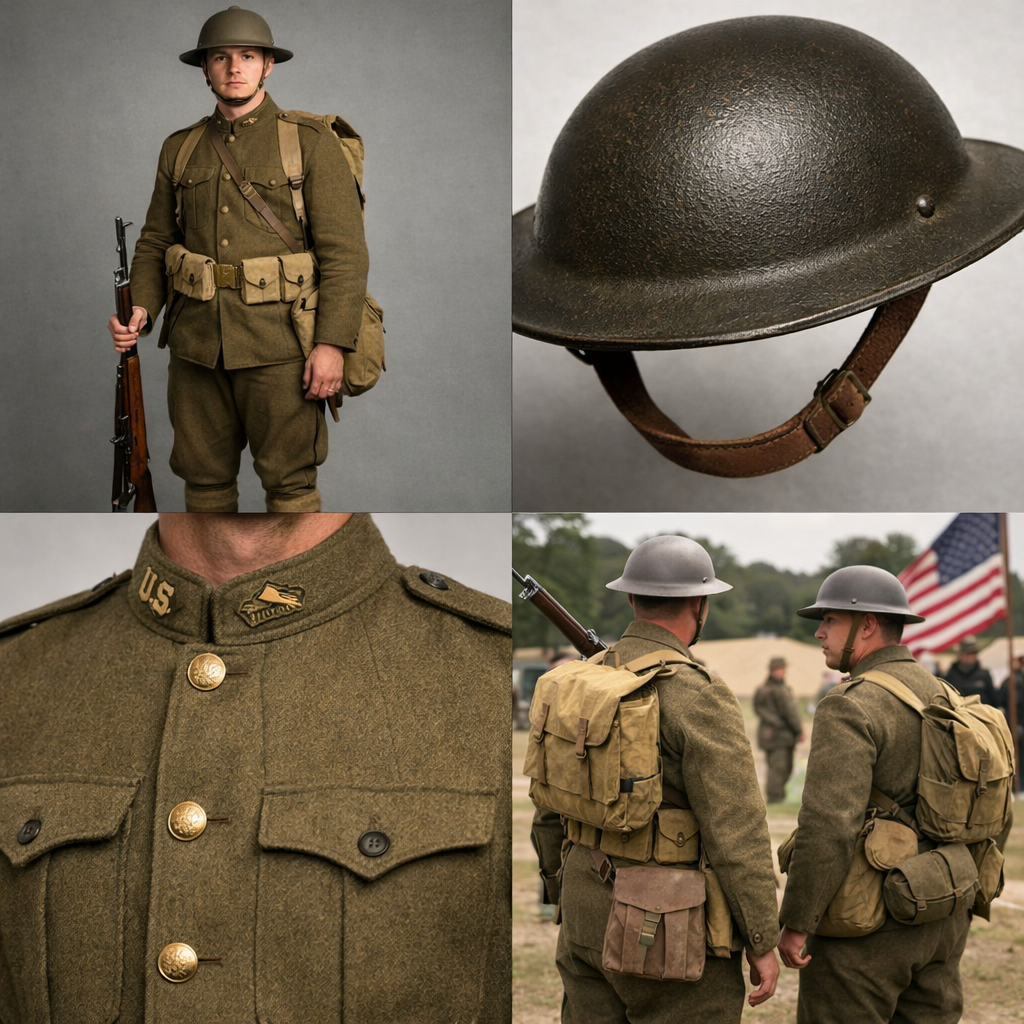
When General John J. Pershing led the American Expeditionary Forces (AEF) to France in 1917–1918, US troops wore the M1912 and later M1917 service uniforms. These were practical field uniforms built for trench warfare conditions in Europe.
Key Parts of the WW1 Uniform
1. Service Coat (Jacket)
The WW1 US Army service coat was made from olive drab wool. The color was a brownish green tone, not bright green. Fabric weight typically ranged around 16–20 oz wool, depending on manufacturer.
Key features:
-
Four front patch pockets
-
Stand-and-fall collar
-
Brass US buttons
-
Olive drab lining
-
Straight body cut
The collar often carried “U.S.” and branch insignia discs. Stitching was simple and functional. No modern tailoring lines. If the reproduction jacket is slim-fit or very tapered, that’s a red flag.
2. Trousers
WW1 trousers were also olive drab wool. They were straight cut and designed to be worn with puttees (cloth leg wraps) over ankle-high boots.
Look for:
-
High waist rise
-
Button fly
-
Reinforced seat area
-
Simple belt loops or suspender buttons
If the trousers look like modern dress pants, skip them. Original designs were loose enough for movement in trenches.
3. M1917 Steel Helmet
The M1917 helmet was based on the British Brodie helmet. It was made from manganese steel and weighed around 2.5 to 3 pounds (about 1.1–1.4 kg).
Key specs:
-
Wide brim
-
Shallow dome shape
-
Rough textured paint finish
-
Simple liner with oilcloth and felt
If a helmet feels too light, it’s likely thin steel or a costume piece. A proper reproduction should feel solid and balanced on the head.
4. Puttees and Boots
Puttees were long wool strips wrapped from ankle to knee. Boots were brown leather with hobnails in many cases.
Reproduction tip: Cheap synthetic puttees look wrong immediately. Wool texture matters.
Real-World Wins and Fails
Let’s talk about what actually happens in the field.
Reenactor Stories
At events like large-scale WW1 reenactments held near historic sites in the US, experienced participants can spot mistakes quickly.
Win Example:
One reenactor invested in a full wool uniform set with correct brass buttons, proper M1917 helmet weight, and period-correct web gear. At a Gettysburg living history event, visitors often asked him detailed questions because his uniform matched archival photos from 1918. His gear held up in rain and cold conditions.
Fail Example:
Another participant bought a budget “WW1 costume” online. The jacket was polyester blend. The helmet was thin stamped steel under 2 pounds. Under sunlight, the fabric color looked bright green instead of olive drab. Within hours, other reenactors pointed out the inaccuracies.
That’s the agitation part. When your uniform is wrong:
-
Photos look inaccurate
-
Group standards may reject you
-
Money gets wasted
-
The experience feels less authentic
WW1 reenacting is about respect for history. Pershing’s AEF soldiers fought in harsh trench systems in 1918. Their uniforms were built for mud, cold, and field conditions. Wearing a poor copy does not reflect that reality.
How to Spot and Buy the Best Reproduction
Now let’s focus on the solution.
Reliable reproduction sellers like paddelaters.com offer historically inspired WW1 US Army uniform replicas. But even then, you should know what to check.
Step-by-Step Checklist
1. Fabric Details
Ask or check:
-
Is it 100% wool?
-
What is the fabric weight?
-
Is the shade olive drab brown tone?
If no fabric information is provided, that’s a warning sign.
2. Hardware and Buttons
Original WW1 service coats used brass buttons with US insignia. Plastic buttons are incorrect.
Check product photos closely. Zoom in.
3. Correct Helmet Specs
For M1917 helmet:
-
Weight close to 3 lbs
-
Thick steel shell
-
Textured paint
-
Period-style liner
If it’s described as “lightweight for comfort,” it’s probably not accurate.
4. Fit and Pattern
WW1 uniforms were not modern slim cut. Look for:
-
Straight body
-
Roomy sleeves
-
High-waisted trousers
Many serious collectors compare reproduction photos with 1918 AEF photos before purchasing.
5. Seller Transparency
Good reproduction sellers list:
-
Materials
-
Measurements
-
Historical references
-
Clear images
Sites like paddelaters.com often structure product listings clearly, making it easier to compare specs with historical records.
FAQs
1. How much does a WW1 US Army uniform cost?
A full reproduction set (jacket, trousers, helmet) can range from $250 to $600 depending on quality and materials. Full gear setups with web equipment cost more.
2. Was the WW1 US Army uniform green?
It was olive drab, which is a brownish green shade. It was not bright green.
3. How heavy was the M1917 helmet?
Around 2.5 to 3 pounds depending on liner and steel thickness.
4. Did US troops use British-style helmets?
Yes. The M1917 helmet was based on the British Brodie design and adopted in 1917.
5. Can I use a WW2 helmet for WW1 reenactment?
No. The shapes and designs are different. WW2 US helmets (like the M1) have a deeper dome and different liner system.
6. Are reproductions good for display?
Yes, high-quality wool reproductions are excellent for collectors who want historical accuracy without paying original antique prices.
Conclusion
Building a WW1 US Army uniform setup does not have to be confusing. Once you understand the specs—olive drab wool, correct cut, proper M1917 helmet weight—you can filter out poor copies fast.
Remember the goal: accuracy and respect for history. Pershing’s AEF troops in 1918 wore practical field uniforms built for real combat conditions.
Do your checks. Compare specs. Choose reliable reproduction sellers like paddelaters.com.
Then suit up properly and step into history.
Grab yours today and build a uniform that truly represents a WW1 American soldier.
