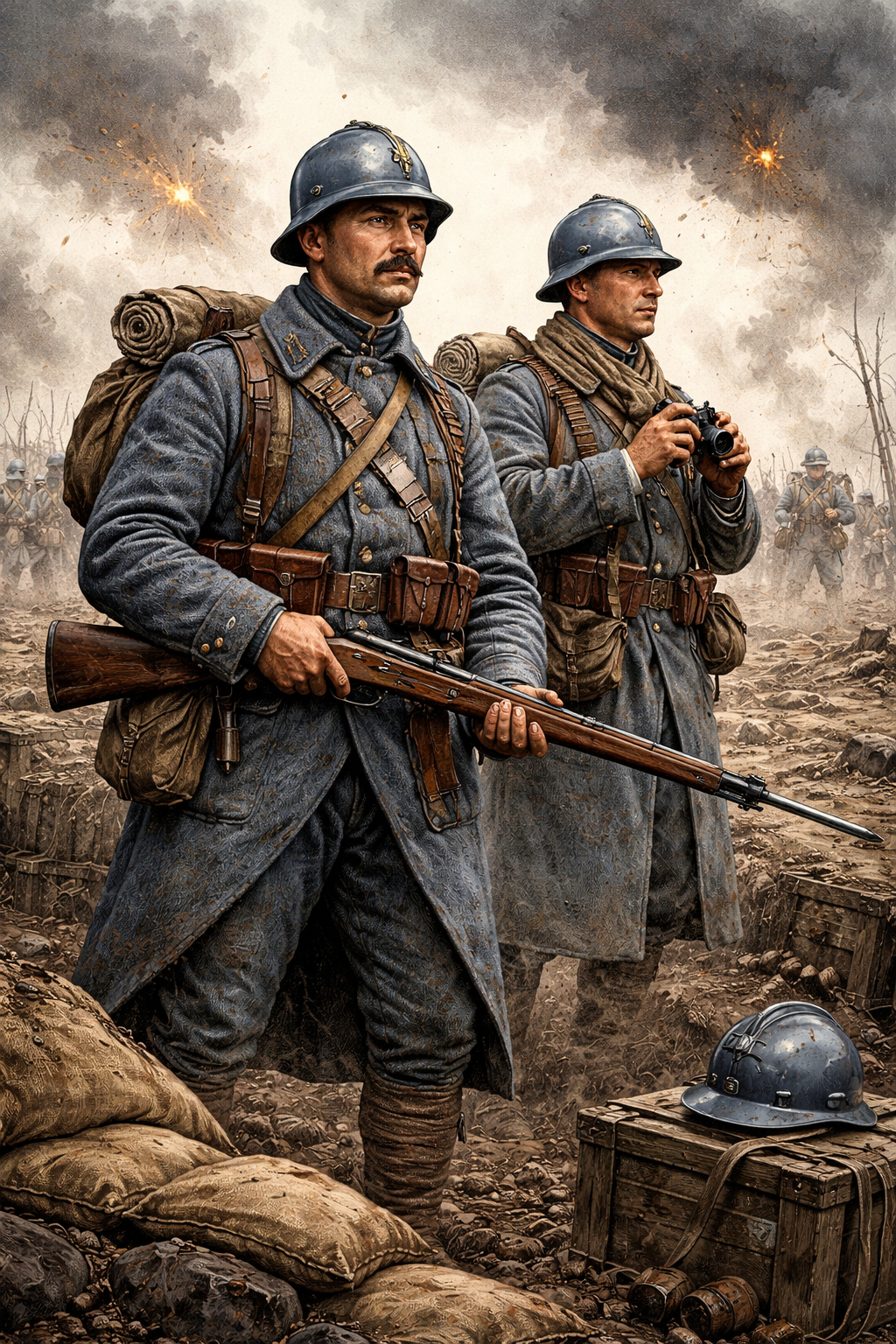
In 1915, General August-Louis Adrian introduced a steel helmet. It became known as the Adrian helmet (Model 1915).
Before this, French troops wore soft caps. Shell fragments from artillery caused deadly head wounds. Military medical reports showed head injuries were common and often fatal.
The Adrian helmet was made of mild steel. It had:
-
A dome
-
A crest on top (for deflection)
-
Front badge (flaming grenade for infantry)
-
Liner inside for fit
Specs table:
| Feature | Specification |
|---|---|
| Model | M1915 Adrian |
| Material | Mild steel |
| Weight | ~0.7–0.8 kg |
| Production | Over 20 million units (France + exports) |
| Introduced | 1915 |
According to French military records cited by the Imperial War Museum, helmet use reduced head wound mortality by a large margin. Some studies show head injury deaths dropped by up to 75% after helmet adoption.
By 1916, nearly all French frontline troops wore Adrian helmets.
That’s a major shift in survival odds.
Pros and Cons in Battle
Pros:
-
Reduced fatal shrapnel wounds
-
Lightweight compared to later helmets
-
Quick mass production
-
Boosted soldier confidence
Cons:
-
Thin steel; limited bullet protection
-
Crest could catch debris
-
Not as strong as later German Stahlhelm
At Verdun (1916), artillery bombardment lasted months. French forces suffered about 377,000 casualties. But with helmets in use, survival from head shrapnel improved compared to 1914 levels (Clayton).
The helmet did not stop rifle bullets at close range. But it was never designed for that. It was built for shell fragments—the main killer.
Real-World Examples from the Trenches
1. Verdun 1916
At Verdun, German artillery fired millions of shells. French troops rotated constantly through the sector.
Medical data showed fewer fatal head injuries compared to early 1914 battles. Helmets deflected fragments falling from above. Soldiers reported dents in helmets where shrapnel would have split skulls.
One French report noted that many men survived blasts due to helmet protection (Imperial War Museum archive commentary).
2. Somme 1916 (French Sector)
In the southern sector of the Somme, French forces attacked alongside British troops. By then, horizon blue uniforms and Adrian helmets were standard.
Although casualties remained high, concealment was better than in 1914 open-field battles. Artillery wounds remained severe, but helmet adoption reduced exposed head fatalities.
3. Chemin des Dames 1917
The Nivelle Offensive failed and morale collapsed. But equipment was modern by then.
Soldiers had:
-
Steel helmets
-
Standardized uniforms
-
Improved trench gear
The issue here was strategy, not gear. Casualties were high, but equipment was no longer outdated. The army had adapted.
FAQs
1. Why did France use red trousers in 1914?
Tradition and belief in visible courage. It was outdated thinking by modern war standards.
2. When was the horizon blue uniform introduced?
Officially in 1915.
3. How many Adrian helmets were made?
Over 20 million units, including exports to other nations.
4. Did the Adrian helmet stop bullets?
Not reliably. It was designed mainly for shrapnel protection.
5. Why is the helmet crest important?
It helped deflect falling debris and reinforced the structure.
6. What caused most WW1 casualties?
Artillery shells, not rifle fire.
7. How heavy was a French soldier’s kit?
Often 25–30 kg including rifle and supplies.
Conclusion
At the start of WWI, French soldiers entered battle with bright uniforms and no steel helmets. Modern artillery made that deadly. Casualties in 1914 proved the gear was outdated.
That’s the problem.
The Agitate phase came at Verdun, Somme, and Chemin des Dames. Shells rained down. Head wounds were common. Losses were massive.
The Solution came through adaptation:
-
Horizon blue uniforms improved concealment
-
Mass-produced wool kits standardized supply
-
The Adrian helmet reduced fatal head injuries
By 1916, France had modernized its frontline equipment. The helmet alone changed survival rates. It did not win the war by itself. But it saved thousands of lives.
When you look at a WW1 French uniform today, especially the Adrian helmet, you’re not just seeing cloth and steel. You’re seeing a lesson learned the hard way—adapt or lose men fast.
