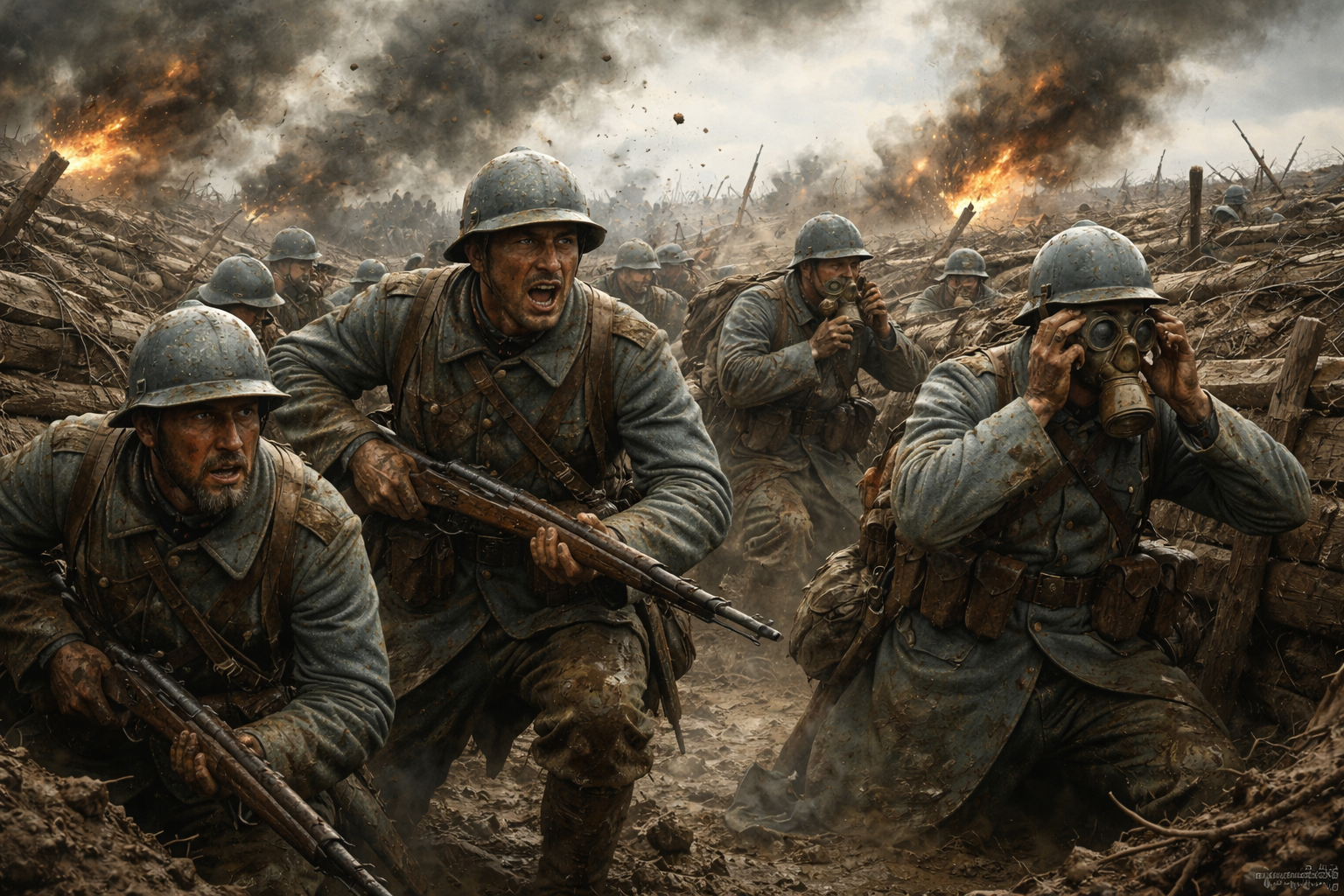
Introduction – The Somme, Mud, and Blue Cloth
Picture the Battle of the Somme in 1916. French troops move through mud that pulls boots off feet. Shells fall every few minutes. Gas hangs low in the air. Over 200,000 French casualties are recorded in this campaign alone when counting killed, wounded, and missing (British and French official Somme records, 1916).
Now look at what many soldiers are wearing. Cloth uniforms. Puttees wrapped tight. Packs heavy with gear meant for marching, not hiding. Ever wonder why French troops stood out so clearly in the early war? The answer sits in the uniform.
The WW1 French uniform tells a hard story. It shows how tradition collided with industrial war. It also shows how change came slowly, paid for in lives.
The Problem: Uniforms in the Face of Massive Casualties
When war began in 1914, France entered with confidence—and outdated gear. Early uniforms still carried bright elements from the 19th century. These were designed for visibility and pride, not survival in machine-gun fire.
France lost around 1.4 million soldiers killed and over 4 million wounded during the war (French National Archives; Jay Winter, Sites of Memory). Uniforms were not the only reason, but they played a role.
Bright clothing made soldiers easier targets. Thin cloth offered no protection against shell fragments. Heavy gear slowed movement during attacks. In trench warfare, small disadvantages turned deadly fast.
Alistair Horne notes in The Price of Glory that French command underestimated how quickly firepower had changed warfare. Uniform reforms followed bloodshed, not foresight.
French Soldier Life on the Frontlines
Daily life for a WW1 French soldier was harsh. Diaries from Poilus describe soaked uniforms that never dried. Mud froze in winter and baked hard in summer. Lice lived in seams.
Louis Barthas, a cooper turned infantryman, wrote that uniforms became “second skins of dirt and sweat” during long trench rotations (Barthas diaries, published 1978).
Uniform weight mattered. Soldiers carried coats, packs, ammunition, tools, and food. Moving fast under fire was hard. Crawling was worse. At the Somme, rain turned fields into glue-like mud, making uniforms heavier with every step.
Gas added another layer of danger. Early gas masks were basic and uncomfortable. Cloth absorbed chemicals, forcing soldiers to strip and burn uniforms after attacks (French Army medical reports, 1915–1916).
Key Features of WW1 French Uniforms
Understanding the WW1 French uniform means breaking it into parts: cloth, color, headgear, and equipment. Each evolved under pressure.
Evolution from Blue to Horizon Blue
At the start of the war, French troops wore dark blue coats and red trousers. These stood out sharply in open fields. Casualty reports from 1914 show heavy losses during early attacks, especially in Alsace and Lorraine (French General Staff reports, 1914).
By late 1914, France introduced horizon blue. This light blue-gray shade blended better with mist, smoke, and distance. It was not camouflage by modern standards, but it reduced visibility compared to earlier colors.
Production was slow. Dye shortages and factory limits meant mixed uniforms appeared for months. Some Somme units in 1916 still wore older items alongside newer ones (French supply records, Service Historique de la Défense).
Helmet and Equipment Details
One of the biggest changes was the Adrian helmet, introduced in 1915. Before this, French soldiers wore soft caps that offered no protection.
The Adrian helmet reduced head wounds from shell fragments by a reported 20–30% in some units, according to French medical statistics (1915–1917). It was light, steel, and easy to mass-produce.
Other equipment evolved too. Packs were simplified. Webbing improved. Gas masks became more effective after 1916. These changes did not stop casualties, but they lowered avoidable deaths.
Pros and Cons in Real Battles
Uniforms are tools. On the Somme and other fronts, their strengths and limits were clear.
Pros:
-
Horizon blue reduced long-range visibility compared to earlier uniforms.
-
Adrian helmets saved lives from shrapnel.
-
Standardized gear improved supply and repairs.
Cons:
-
Cloth offered no real ballistic protection.
-
Uniforms soaked water and chemicals.
-
Poor insulation caused illness in winter trenches.
At the Somme, even improved uniforms could not counter artillery that fired millions of shells. Still, small gains mattered when survival odds were thin.
Real-World Examples from French Soldiers
Real voices show how uniforms shaped life and death.
Example 1: Louis Barthas (Argonne, 1915)
Barthas wrote that the new helmet felt strange but quickly became trusted after seeing it stop metal fragments (Barthas diaries).
Example 2: Verdun Poilu Letters (1916)
Letters collected in the French National Library describe horizon blue coats blending into smoke during bombardments, helping soldiers avoid sniper fire.
Example 3: Somme Infantry Reports (1916)
Unit reports note fewer head injuries after helmet adoption, even as overall casualties stayed high due to artillery (French Army Medical Corps).
Example 4: Gas Attack Survivors
Soldiers recalled burning uniforms after chlorine gas exposure, showing how cloth absorbed deadly chemicals (French medical logs, Ypres and Somme sectors).
These examples ground the WW1 French soldier experience in daily reality, not theory.
FAQs
How many French died in WW1?
About 1.4 million French soldiers were killed, with millions more wounded (French Ministry of Defence).
Why were early WW1 French uniforms so visible?
They followed 19th-century ideas of morale and tradition, not modern combat needs.
What was horizon blue?
A blue-gray cloth color adopted from late 1914 to reduce visibility on the battlefield.
Did helmets really help?
Yes. The Adrian helmet significantly reduced head wounds from shrapnel (French medical records).
Were uniforms the main cause of French casualties WW1?
No. Artillery and tactics caused most losses, but uniforms affected survival chances.
Did all French soldiers get new uniforms quickly?
No. Supply shortages meant mixed gear lasted well into 1916.
Conclusion – Lessons Written in Cloth
The WW1 French uniform is a record of learning through loss. France entered the war with outdated ideas and paid for them in blood. Through battles like the Somme, uniforms changed step by step—horizon blue replaced bright colors, helmets replaced caps, and equipment slowly matched the reality of trench war.
These changes did not end suffering. France still faced massive French casualties WW1. But they saved lives at the margins, where survival often came down to chance.
When you study a WW1 French soldier, you are not just looking at fabric. You are seeing decisions, delays, and hard-earned lessons from one of history’s deadliest wars.
Pros and Cons of WW1 French Uniforms
| Aspect |
Pros |
Cons |
| Color |
Horizon blue reduced visibility |
Still visible at close range |
| Helmet |
Reduced head injuries |
No full-face protection |
| Material |
Easy to produce |
Poor against mud, gas, cold |
| Equipment |
Standardized supply |
Heavy and restrictive |