FRENCH WW1 CASUALTIES: RAW NUMBERS & BATTLES
Introduction
Imagine Private Louis Barthas, a simple barrel maker from southern France. It's 1916 near Verdun. Shells explode nonstop. Mud pulls at his boots like quicksand. Friends vanish in the blasts—one minute joking, next gone. You know that gut punch from reading old diaries? France stared down massive losses from day one. Official counts show 1,397,800 dead or missing by 1919. That's out of 8.4 million mobilized—nearly every able man.
The problem grew huge fast. Early 1914 battles alone took 300,000 lives. Families back home scanned newspapers daily. Telegrams arrived with black borders. France fought on its own soil, no fallback. You ever think how that pressure builds? By 1916, Verdun and Somme ground up entire divisions. Replacements came green, straight from farms. The army shrank while Germany pressed. Homefront women worked factories, kids went hungry. These weren't abstract numbers. They were brothers, fathers, sons. France bled to hold the line, but at what cost? Let's break down the raw scale next.
The Scale of French Losses
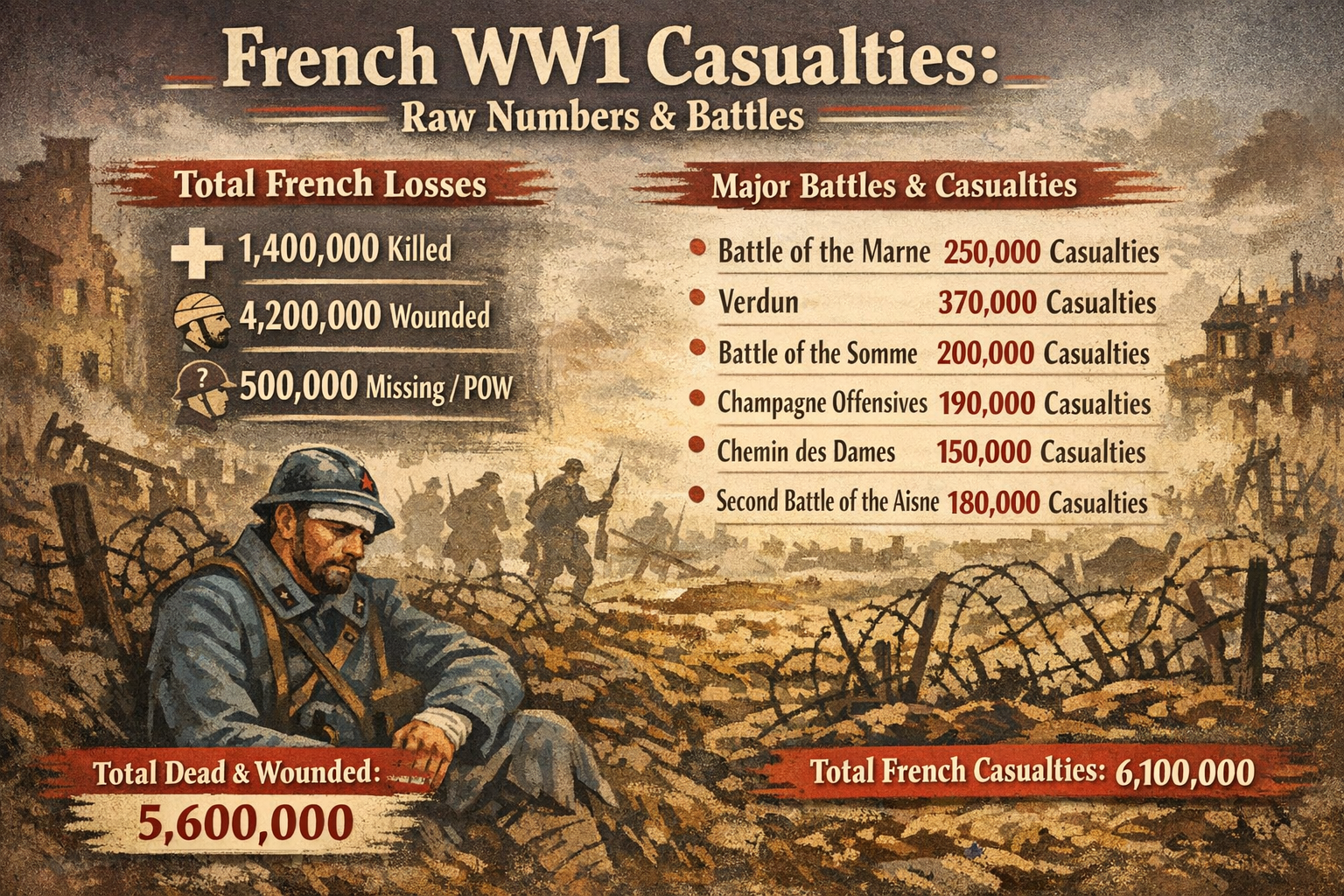
France mobilized 8.4 million men from 1914-1918. Total casualties topped 6 million: 1.3-1.4 million dead, 2.8 million wounded, 300,000 captured or missing. Battle deaths: 675,000. Died of wounds: 250,000. Disease and accidents: 175,000. Colonial forces from Africa and Asia added 35,200 dead.
Daily rates paint the grind. Overall average: 1,020 deaths per day over 1,365 days of war. Broke down yearly:
-
1914: 301,000 dead. Peak 2,220 daily in the Battle of the Frontiers. August 22: 27,000 killed—worst single day for any nation.
-
1915: 290,000 dead. 1,180 daily amid Champagne and Artois pushes.
-
1916: 362,000 dead. 990 daily, driven by Verdun and Somme bloodbaths.
-
1917: 83,000 battle deaths, but mutinies hid morale collapse. 520 daily.
-
1918: 220,000 dead. Spring offensives hit 970 daily before Allied surge.
Units turned over multiple times. Infantry regiments averaged 600% casualties—six full strengths wiped out. By war end, 71% of mobilized were casualties. Replacements dwindled; 1918 classes called boys of 16 and men over 50. Homefront felt it—birth rates crashed 40%. Factories ran short on labor. You see how losses snowballed? No quick fixes when your pool runs dry.
Key Battles That Broke the French Army
Verdun
Germans launched February 21, 1916. Goal: "Bleed France white." Ten months of hell. French took 377,000 casualties—163,000 dead, 215,000 wounded or gassed. Germans matched at 337,000. Daily clip: 1,200+ casualties each side.
Fort Douaumont fell March 2—100 Germans vs. 57 dazed French. Pétain rushed 20 divisions, set noria rotation: fresh troops cycled in-out. Fleury village flipped 16 times. Meuse Heights became graveyards. 27th Infantry Division plugged gaps; its 114th and 121st Battalions shredded holding hills. December counterattacks reclaimed forts. France held—but lost a generation's worth in mud.
Somme
British kicked off July 1, 1916. French Sixth Army joined south of river. Advanced farther than Brits initially, but stalled. French losses: 194,000-202,000 killed/wounded. Germans: 500,000 total. French captured Maurepas, Bouchavesnes, but machine guns and mud claimed thousands daily.
Chemin des Dames
Nivelle's April 16, 1917 offensive. Promised breakthrough. Day one: 40,000 French casualties. Total: 187,000 in 10 days; 134,000 by May end. Germans: 163,000. Creeping barrage failed—infantry caught in own fire. Caves along ridge sheltered Germans. Sparked mutinies: 68 divisions rebelled.
These ate 750,000+ casualties combined. Divisions dissolved; mutinies forced Pétain's reforms. You feel the breaking point?
What Caused Such High Casualties?
Machine guns cut down waves—75 rounds per second. Artillery inflicted 70% losses: shrapnel, high explosives from three directions at Verdun. Gas blinded, choked thousands post-1915. Tangled wire funneled men into kill zones.
Tactics lagged. 1914 mass assaults echoed Napoleonic charges—straight into guns. Joffre stripped forts prewar, left Verdun thin. Nivelle hyped 1917 attack despite intel, ignored failed rehearsals. Logistics hurt: German raids cut rail lines early.
Pros: Soldier grit. Held Marne 1914, Verdun 1916 against odds. Colonial Senegalese, Algerians filled gaps bravely. Pétain's defense-in-depth rotated troops, saved morale.
Cons: Rigid high command. No infiltration tactics till late. Overreliance on élan—spirit over fire support.
Bravery met bad planning. Result: piles of dead. You know that mix?
Real-World Examples from the Trenches
Diaries cut through stats. Louis Barthas at Verdun: "Shells everywhere. Rats size of cats. Mates buried alive." 151st Infantry Regiment lost 16,000 over war—replaced nine times.
27th Infantry Division, Verdun: Stormed under barrages, lost half in days holding Douaumont sector. Another: 22nd August 1914, Rossignol—27,000 dead in hours; units overran by Uhlans.
Homefront crumbled. 1917 mutinies: 30,000-40,000 refused orders post-Chemin des Dames. Demanded food, leave—not suicide attacks. Flu 1918 killed extra 200,000 civilians. Widows sewed uniforms, starved on rations. Letters home: "Lost my best friend Friday." Real men cracked under endless grind.
Pros, Cons, and Lessons Today
Pros: Unmatched resilience. Rotated 300 divisions through Verdun—noria kept fight alive. Bravery won key stands like Marne.
Cons: Tactical blindness. Mass attacks wasted lives; mutinies exposed rot.
Lessons shape today. Armies prioritize combined arms—tanks, air, infantry. Tech cuts human cost: drones over charges. Remembrance lives in Douaumont Ossuary—250,000 bones. Ties to now: Plan wars smart, value troops. History warns against attrition grinds.
FAQs
-
How many French died at Verdun? 163,000 dead, 377,000 total casualties.
-
French Somme losses? 194,000-202,000.
-
WW1 French daily deaths? Average 1,020; 1914 2,220.
-
Chemin des Dames toll? 187,000 French.
-
Total French WW1 dead? 1.3-1.4 million.
-
Worst single day? August 22, 1914: 27,000 killed.
Conclusion
France turned the tide through grit and reform. Pétain fixed mutinies with better leave, food, and defenses—no more suicide charges. Tactics shifted to defense-in-depth, buying time for tanks and Allies in 1918. You know how that saved the nation? Lessons cut deep today: wars demand smart plans, not just bodies. Modern militaries drill combined arms, tech over mass assaults. Honor the fallen at places like Verdun Ossuary, where bones of 250,000 rest. These stories remind us—value every soldier. Ready to own a piece of that history? Check our WW1 French uniform replicas at paddelaters.com. Step into the trenches yourself
