GERMAN UNIFORM EVOLUTION: WW1 BATTLE GEAR TO WW2 REPRO KITS
Published on Feb 09, 2026
Introduction — The Problem Behind Historic Uniforms
If you enjoy military history, sooner or later you hit a problem: uniforms are confusing. Originals are rare, expensive, and often damaged. Reproductions are everywhere, but quality varies a lot.
During WW1 and WW2, uniforms were not made for collectors. They were made for survival. Soldiers fought in mud, rain, snow, and artillery fire. Uniforms tore, got soaked, and wore out fast. Records from institutions like the Imperial War Museum show how trench conditions destroyed clothing within weeks.
Fast forward to today. Collectors and reenactors want authenticity. But original uniforms are fragile museum pieces now. So modern reproduction uniforms step in as the practical solution.
Let’s break down how WW1 originals actually worked in battle and how WW2 reproduction uniforms help history stay alive today.
WW1 German Uniforms: Key Features and Historical Case Study
Design and Materials
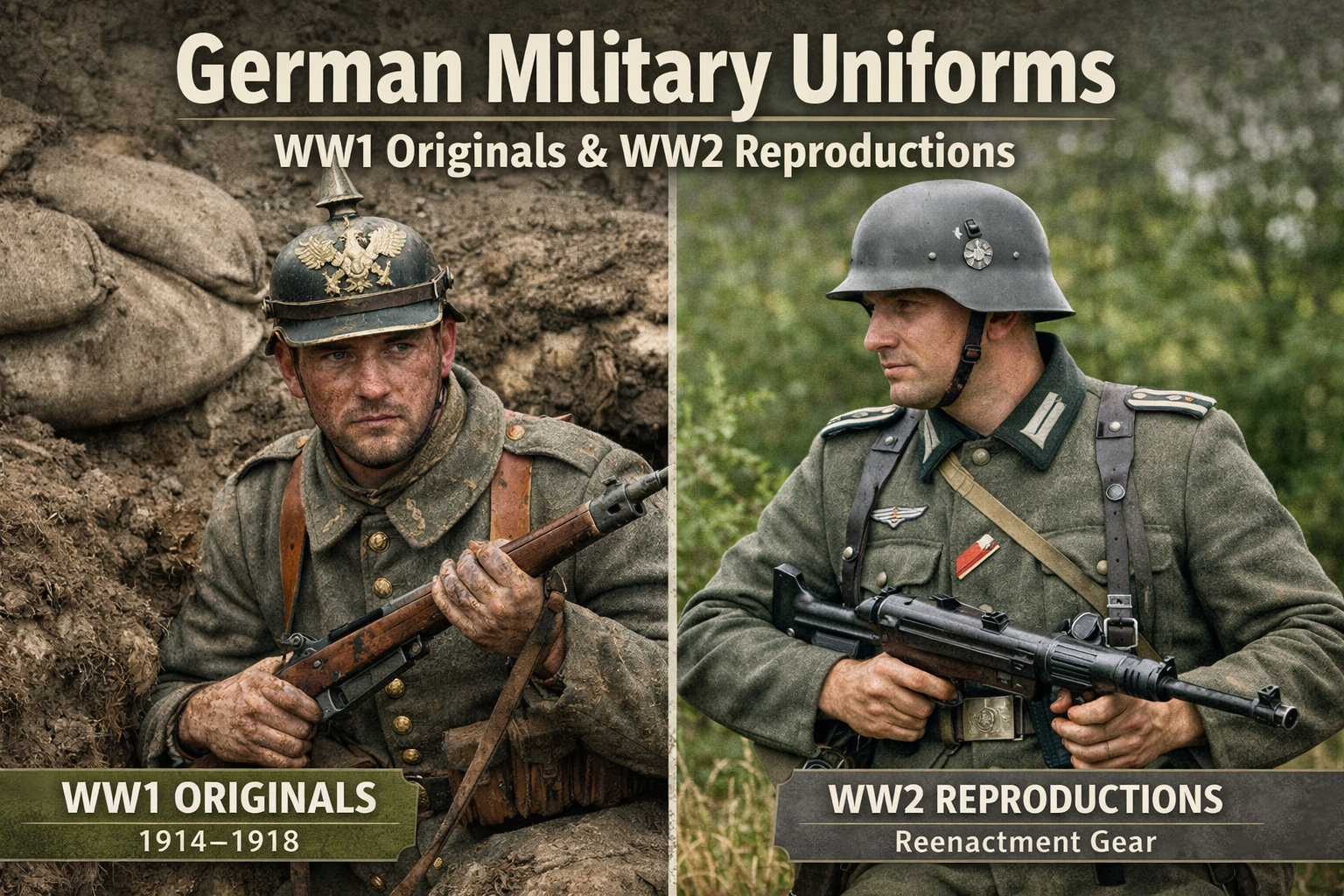
At the start of WW1 in 1914, German soldiers wore colorful uniforms with spiked helmets called Pickelhauben. But this changed quickly. Bright colors made soldiers easy targets.
By 1915, the German army switched to feldgrau, a gray-green color that blended better with terrain. According to uniform studies documented in military archives and collector research, standard German WW1 uniforms included:
-
Heavy wool tunic and trousers
-
Feldgrau field color
-
Leather belts and ammunition pouches
-
Long boots or ankle boots with puttees
-
Steel helmet introduced in 1916 (Stahlhelm)
Wool was strong but had problems. It absorbed water easily. In trench conditions, uniforms became wet and stayed wet. Soldiers often suffered from cold exposure and trench illnesses.
Uniform supply also became difficult later in the war. Germany faced shortages, so materials became rougher and designs simpler by 1917–1918.
Original WW1 uniforms you see today often show repairs, patches, and mismatched parts because soldiers kept reusing clothing.
Real-World Example from the Somme Offensive
The Battle of the Somme in 1916 shows how uniforms performed in real combat.
German soldiers defending trench positions wore early feldgrau uniforms without enough waterproof protection. Reports from battlefield studies show trenches filled with mud and water. Soldiers sometimes stood in wet conditions for days.
Uniforms became heavy and uncomfortable. Wool coats soaked up rain, making movement harder. Boots rotted, and socks rarely dried. Many soldiers suffered trench foot due to constant moisture.
This shows uniforms were not just clothing — they directly affected survival and fighting ability.
Today, surviving uniforms from battles like the Somme are rare because most were destroyed or reused after the war.
WW2 Reproduction Uniforms: Modern Features and Pros/Cons
Reproduction Quality and Sourcing
Original WW2 uniforms are even harder to find in wearable condition. So modern reproduction uniforms are widely used instead.
Reproduction uniforms copy German army clothing described in works like Osprey Publishing’s The German Army 1939–45. Typical reproduced items include:
-
M36 or M40 field tunics
-
Field-gray wool uniforms
-
Reproduction insignia
-
Leather gear and boots
-
Stahlhelm helmet replicas
Modern reenactors across Europe and the US use these uniforms regularly. Events like the War & Peace Revival in the UK show hundreds of participants wearing WW2 German reproduction uniforms to recreate historical scenarios.
Modern manufacturers often improve durability:
-
Stronger stitching
-
Better sizing options
-
Blended fabrics for comfort
-
More durable boots
However, quality differs widely. Some cheap versions look incorrect or wear out quickly. High-end reproductions aim to match original stitching and fabric weight closely.
Another real-world example comes from film production. Movies and documentaries use reproduction uniforms because originals are too fragile and expensive to risk.
Pros & Cons of Collecting or Reproducing These Uniforms
If you are thinking about collecting or reenacting, here’s the reality.
Pros of Original Uniforms
-
True historical value
-
Rare collector items
-
Museum-level authenticity
Cons of Original Uniforms
-
Very expensive
-
Fragile fabric
-
Hard to maintain
-
Risk of damage if worn
Pros of Reproduction Uniforms
-
Affordable compared to originals
-
Safe to wear
-
Good for reenactments and events
-
Widely available
Cons of Reproduction Uniforms
-
Quality varies
-
Some lack authenticity details
-
Can still be costly if high quality
Most reenactors choose reproduction gear while collectors display originals safely.
FAQs
1. Are WW2 reproduction uniforms legal to own?
Yes, in most countries they are legal for collecting, reenactment, or education, as long as they are not used for promoting extremist views.
2. Why are original WW1 uniforms so expensive?
Few survived because most were destroyed, reused, or worn out during and after the war.
3. Can reproduction uniforms look exactly like originals?
High-end reproductions can look very close, but fabric aging and wear patterns are hard to copy.
4. Are originals safe to wear?
Usually not. Old wool and stitching can tear easily.
5. What should beginners buy first?
Start with reproduction gear to learn before investing in expensive originals.
6. How can you spot fake originals?
Check stitching, fabric aging, markings, and provenance. Many collectors consult expert forums or dealers.
7. Do reenactments use real uniforms?
Mostly reproductions, to protect historical artifacts.
Conclusion — The Solution for History Fans Today
So here’s the solution to the uniform challenge.
WW1 German uniforms show how soldiers adapted to brutal trench warfare. But surviving originals are rare and fragile today.
WW2 reproduction uniforms solve a modern problem. They allow reenactors, filmmakers, and history fans to experience military history without risking real artifacts.
If you love military history, you don’t need to chase rare museum pieces immediately. Start with quality reproductions, learn the details, attend events, and connect with collectors.
History becomes real when you see, feel, and understand the equipment soldiers actually used.
