HOW TO IDENTIFY AUTHENTIC WW1 BRITISH UNIFORMS
Introduction: A Tunic from the Trenches
Imagine holding a khaki tunic worn in 1916 on the Somme. The wool feels heavy. The brass buttons are dull from age. Inside, you see a faded label with a date stamp: 1915. That’s not just cloth. That’s history.
Now picture a nurse’s apron from a field hospital near Ypres. White cotton. Red Cross armband. Simple design, built for long hours and rough conditions. It tells a different story. Not about fighting in trenches, but about saving lives.
Here’s the problem. If you try to buy one of these today, you’ll quickly face confusion. Many uniforms on the market are reproductions. Some are mixed with modern parts. Others are priced very high without proof. Even experienced collectors struggle.
So how do you avoid wasting money? How do you tell a real 1914–1918 uniform from a modern copy?
Let’s break it down step by step.
Key Features of WW1 British Soldier Uniforms
Khaki Fabric, Badges, Headgear
When the war began in 1914, the British Army already used khaki service dress. According to British Army regulations from 1902 onward, the standard soldier’s uniform included a khaki wool tunic and trousers made from wool serge. The weight of serge often ranged around 18–20 ounces per yard, strong enough for field use.
Tunic Design (1914 Pattern Service Dress):
-
Four front pockets with pleats.
-
Brass general service buttons.
-
Stand-and-fall collar.
-
Shoulder straps for rank and regimental titles.
The Imperial War Museum holds multiple examples of 1914 and 1915 pattern tunics. Many have internal stamps showing the year, contractor name, and size. These stamps are key for collectors. A missing or blurred stamp does not mean fake, but clear stamps help with verification.
Badges and Insignia:
-
Cap badges made of brass or bronze.
-
Shoulder titles showing regiment name.
-
Rank stripes (chevrons) sewn on sleeves for NCOs.
A common mistake collectors make is trusting shiny badges. Original WW1 brass often shows natural aging. If a badge looks too bright, it may be cleaned or replaced.
Headgear:
-
The 1902 Service Dress cap.
-
The Brodie helmet introduced in 1915.
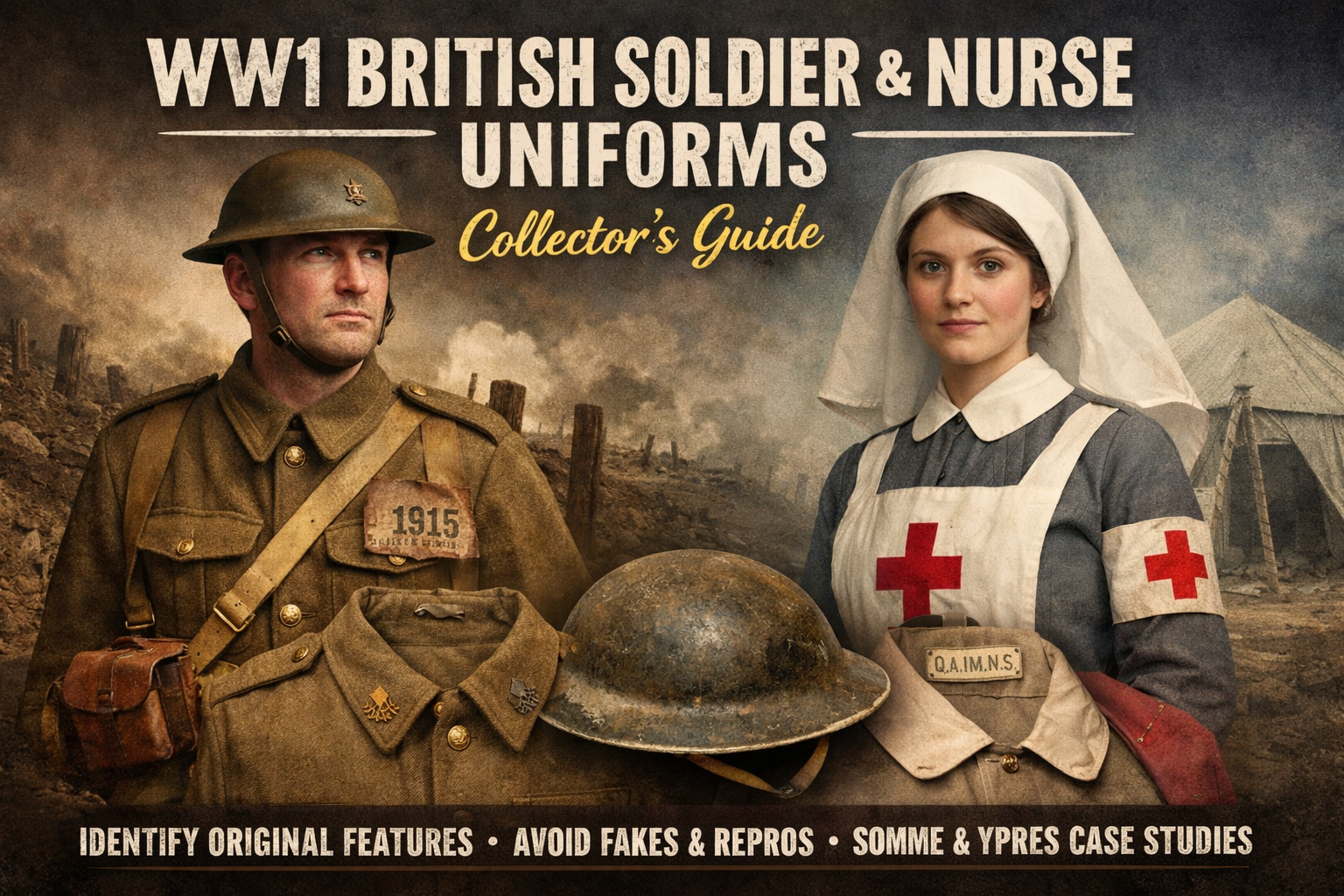
The Brodie helmet is often copied. Originals usually show maker marks inside the rim and a rough, sand-textured paint finish.
If you are buying online, always ask for close photos of:
-
Inside labels.
-
Stitching on pockets.
-
Back of badges.
Small details tell big stories.
WW1 Nurses Uniforms Breakdown
While soldiers wore khaki, nurses wore uniforms based on hospital tradition. Many British military nurses served under Queen Alexandra’s Imperial Military Nursing Service (QAIMNS).
Their uniforms were practical and simple.
Typical Features:
-
Grey or blue dress.
-
White apron.
-
Red Cross armband.
-
Veil or headdress.
-
Cape for outdoor wear.
Records from British Army medical services show that uniform design varied slightly depending on posting. Nurses in France might adapt their clothing for mud and cold. Those in Britain kept more formal dress standards.
The apron was often removable and washed daily. Cotton fabric was common. Veils were pinned carefully and often show small holes where pins were used.
One detail collectors overlook is wear pattern. A real nurse’s apron from 1916–1918 may show staining around the waist or lower hem. A completely spotless piece without signs of age may need closer checking.
Authentic QAIMNS uniforms sometimes include name tags stitched inside. Service records, if available, add strong value.
Real-World Case Study: Somme Uniform Recovery
Let’s talk about a real example.
In 2016, during the 100th anniversary of the Battle of the Somme, remains of British soldiers were still being discovered in northern France. Some finds included uniform fragments: buttons, webbing parts, and cloth pieces.
The Imperial War Museum has documented several Somme-related tunics in its collection. One 1916 tunic showed:
-
Faded khaki color due to trench exposure.
-
Corrosion around brass buttons.
-
Internal stamp dated 1915.
-
Regimental shoulder title partially intact.
Condition notes described heavy wear, small tears, and soil staining. But these signs actually supported authenticity.
Another public sale example involved a verified 1916 British Army tunic sold on eBay UK in 2021. The seller included:
-
Clear photos of internal stamps.
-
Provenance letter linking it to a soldier who served in the Somme campaign.
-
Regimental badge matching service records.
The final sale price was over £1,200. Why so high? Because documentation reduced doubt.
Now consider a Queen Alexandra nurse’s uniform linked to service near Ypres. Auction records from UK military antique dealers show prices ranging between £800 and £1,500 depending on condition and documentation. A named uniform with service papers always commands more.
Here’s the key lesson: condition matters, but documentation matters more.
Pros and Cons for Collectors Today
Let’s be honest. Collecting WW1 uniforms is not easy.
Pros:
-
Strong historical value.
-
Growing interest during centenary events.
-
Tangible link to major battles like the Somme.
-
Stable long-term demand among military collectors.
Cons:
-
High prices.
-
Many reproductions on the market.
-
Risk of mixed parts (original tunic, modern badges).
-
Limited supply of named, documented pieces.
Reproduction uniforms are common for reenactment groups. These are not bad products. But problems start when they are sold as original.
If you are serious:
-
Buy from known military antique dealers.
-
Request written guarantee of authenticity.
-
Compare with museum examples.
The Imperial War Museum website and British Army archives provide free reference images. Use them. Study pocket shapes. Study button types. Train your eye.
Top FAQs
1. How to spot fakes?
Check stitching, fabric weight, and internal stamps. Compare with museum examples. Be careful with very clean items.
2. Are all WW1 uniforms khaki?
Most British Army field uniforms were khaki. Nurses wore grey or blue dresses with white aprons.
3. What is the Brodie helmet?
A steel helmet introduced in 1915. Look for maker marks inside the rim.
4. How much does a genuine 1916 tunic cost?
Prices can range from £800 to over £1,500 depending on condition and proof.
5. Do nurse uniforms cost less than soldier uniforms?
Not always. Named QAIMNS uniforms can reach similar prices due to rarity.
6. Is minor damage a bad sign?
Not necessarily. Real wear often supports authenticity.
7. Can I wash an original uniform?
No. Cleaning can reduce value. Always consult a textile conservator.
8. Where can I verify details?
Use the Imperial War Museum archives and British Army service records.
Conclusion: Smart Steps Before You Buy
So where does this leave you?
If you love history, holding a WW1 British soldier or nurse uniform is powerful. But don’t rush. The market is full of traps. High prices. Mixed parts. Modern copies.
Here’s your action plan:
-
Study real examples from museums.
-
Learn the basic features: four pockets, brass buttons, wool serge.
-
For nurses: grey dress, white apron, veil, Red Cross armband.
-
Ask sellers for inside stamps and clear badge photos.
-
Value documentation over perfect condition.
Remember, a slightly worn 1915 tunic with clear stamps and service history is often better than a perfect-looking piece with no proof.
Collecting is about knowledge. The more you study, the safer your investment becomes.
And when you finally hold that real 1916 tunic or a QAIMNS apron linked to Ypres, you’ll know you didn’t just buy fabric. You bought a story backed by facts.
That’s what makes it worth it.
