Introduction: The Challenges of Early WW1 French Uniforms
When World War I began in 1914, French soldiers faced a host of challenges. The war quickly evolved into a brutal and grueling conflict of attrition, especially in the trenches. One of the most significant issues that hindered their effectiveness was the inadequacy of their uniforms. Designed for conventional warfare, the French uniforms struggled in the face of new, horrific conditions. By 1918, the French army numbered nearly 4 million, under the leadership of President Raymond Poincaré, but soldiers continued to endure harsh realities due to poor uniform design.
The uniform, initially designed for fast mobility, was not suited for the realities of trench warfare, where soldiers were exposed to extreme weather, disease, and the constant threat of death. In this blog, we’ll explore the evolution of the French uniform during WW1, how it shaped the experiences of soldiers, and provide key insights for military history enthusiasts and collectors. Let's dive in!
Who Led France? (Raymond Poincaré's Role)
Army Size Facts
From 1913 to 1920, Raymond Poincaré served as the President of France. His leadership was tested from the very outset of the war. Under his leadership, the French Army grew rapidly in size, eventually reaching nearly 4 million soldiers by 1918. This dramatic expansion brought both logistical challenges and opportunities for improvement, including changes in military gear, most notably uniforms.
At the beginning of the war, France was largely unprepared for the scale of modern warfare, and the French army's uniform was initially intended for different kinds of conflict. The situation was dire as soldiers confronted not just an enemy but environmental and logistical hardships.
Key Features of WW1 French Uniforms
As WW1 progressed, the need for practical and durable uniforms became evident. The French military uniform, originally designed for the 19th century, underwent various updates and modifications throughout the war.
Horizon Blue Evolution
The most iconic feature of the French uniform was its distinct "Horizon Blue" color. Initially, French soldiers wore dark blue coats and red trousers, which proved highly visible on the battlefield and became an easy target for enemy fire. Recognizing this fatal flaw, the French Army introduced the "Horizon Blue" (bleu horizon) in 1915. This new color was designed to blend better with the natural surroundings, offering some degree of camouflage.
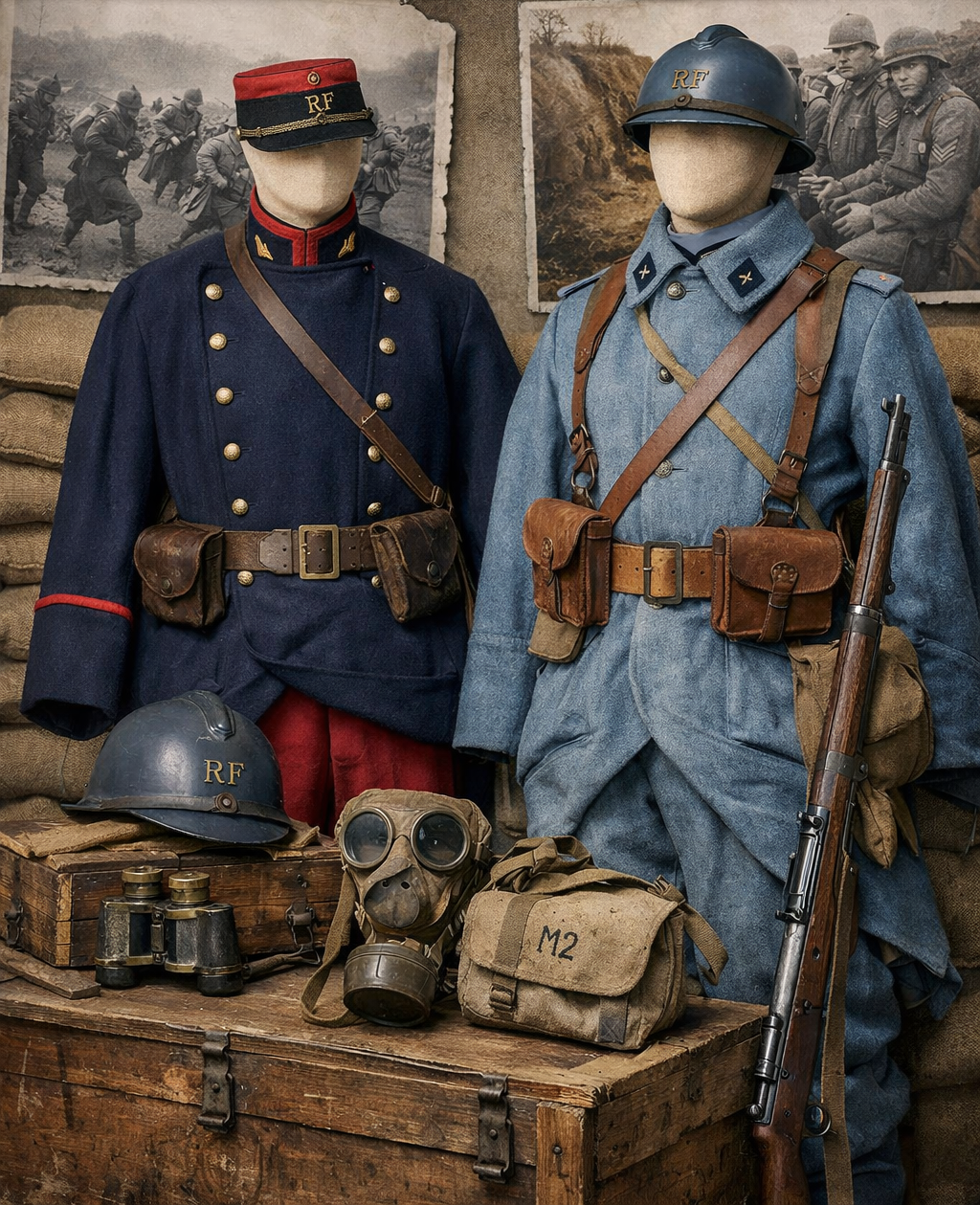
The new uniform consisted of a blue-grey jacket with a stand-up collar, paired with matching trousers. The new design was far more practical, particularly for the changing landscapes of trench warfare. Though it wasn't perfect, it offered a better chance of survival.
Materials and Design Details
The Horizon Blue uniforms were made from wool and could be a bit heavy, especially when soldiers were trudging through wet conditions. The French also used a leather belt with metal buttons and a simple leather or felt hat, which became an iconic symbol of the French infantry.
However, there were complaints about the uniform's comfort. While the wool kept soldiers warm, it did little to protect them from rain or the wet trenches. Over time, as the war dragged on, the French Army began to improve the materials used in uniforms, introducing lighter and more durable fabrics, although some issues remained throughout the conflict.
Pros & Cons in Real Combat
Despite the changes made throughout the war, the French uniform still had its shortcomings when it came to combat.
Case Study - Battle of the Marne
The 1914 Battle of the Marne stands as a defining moment in WW1, where French soldiers, wearing the early versions of the uniform, fought fiercely to repel the German advance. Despite having the advantage of familiarity with the terrain and some tactical success, the French soldiers’ uniforms posed a real challenge. The soldiers were highly visible to the enemy due to the dark blue uniforms and struggled with the extreme weather conditions of the battle, leading to exhaustion and a higher risk of sickness.
While the introduction of Horizon Blue helped with camouflage, the uniform still had its drawbacks. The wool material was not waterproof, and soldiers often had to fight in muddy, wet conditions. Moreover, the heavy leather gear, while durable, became cumbersome during prolonged battles, especially in the tight quarters of the trenches.
The uniforms also lacked the necessary protection against chemical warfare, which became a major threat in later stages of the war. Gas masks and other protective gear had to be developed separately, further complicating the overall experience of soldiers.
Real-World Examples for Collectors
For military history enthusiasts and collectors, the French WW1 uniforms are highly sought after. Numerous museums, such as the Imperial War Museum in London, have preserved original pieces, giving collectors a closer look at these historical garments.
For instance, you can find preserved Horizon Blue uniforms in museums across Europe, including the Musée de l'Armée in Paris, which showcases the evolution of French military gear from the 19th century through WW1.
On eBay and other online platforms, modern replicas of these uniforms are available. These replicas are designed to closely match the original uniforms in terms of color, fabric, and design. Collectors can find full sets, including hats, jackets, and trousers, that resemble the uniforms worn during the Battle of the Marne.
Example Replica for Sale:
-
Horizon Blue French WW1 Infantry Uniform Replica: A detailed reproduction of the 1915 Horizon Blue uniform, available on eBay and other online military stores. Priced between $150-$300, these replicas offer a great option for collectors looking to own a piece of military history.
FAQs
-
Why did the French change their uniform during WW1?
The initial uniform made soldiers highly visible and vulnerable in combat. The introduction of Horizon Blue in 1915 aimed to provide better camouflage in the natural landscape of the trenches. -
What was the most iconic feature of the French WW1 uniform?
The Horizon Blue color, introduced in 1915, became the most iconic feature, as it marked a significant departure from earlier, more visible uniforms. -
Were French WW1 uniforms waterproof?
No, the wool fabric used for the Horizon Blue uniforms was not waterproof, leading to discomfort and potential health risks for soldiers in wet conditions. -
How many soldiers were in the French Army by 1918?
By 1918, the French Army had grown to nearly 4 million soldiers, a massive increase from the initial deployment in 1914. -
Where can I buy a WW1 French uniform replica?
Modern replicas of WW1 French uniforms are available on e-commerce platforms such as eBay and Amazon. Look for those labeled as historically accurate reproductions. -
Were French soldiers equipped with gas masks in WW1?
Yes, gas masks were introduced later in the war after the use of chemical warfare became a significant threat. These were separate from the standard uniform. -
How do I care for my WW1 French uniform replica?
To care for your replica, avoid exposure to extreme conditions like rain, and store it in a dry, cool place. Dry cleaning or gentle hand washing may be required depending on the fabric.
Conclusion
The evolution of French WW1 uniforms, from the initial dark blue designs to the introduction of the Horizon Blue in 1915, was driven by the harsh realities of modern warfare. While these uniforms offered better camouflage, they were not without their flaws, particularly in trench conditions. The French Army, under the leadership of Raymond Poincaré, faced immense challenges, but the introduction of these new uniforms marked a crucial adaptation to the changing landscape of war.
For military collectors, understanding the history behind these uniforms is not just about owning a piece of fabric but about preserving a crucial chapter of military history. If you're interested in owning a replica, there are several options available online. Whether you're a passionate historian or a collector of military gear, a French WW1 uniform is a valuable piece to add to your collection. Check out trusted sellers on eBay or Amazon to find your perfect replica today!
