WHY BRITISH WW2 UNIFORMS CHANGED THE WAY ARMIES DRESSED FOR WAR
Introduction (PAS hook: Problem from WW1 into WW2)
British WW2 uniforms did not start fresh in 1939. They carried a lot of WW1 habits into a new kind of war. After 1918, the British Army cut budgets and leaned on what it already knew. Heavy wool, loose tunics, and puttees stayed in stores and doctrine. On paper, it saved money. In the field, it caused trouble.
When the war opened, British soldiers marched into France wearing gear that still assumed slow movement, short fights, and limited vehicle use. Tanks, aircraft, and fast-moving infantry made those ideas outdated. The problem was not bravery or training. It was clothing that no longer fit how wars were fought.
That gap between old design and new combat showed up fast. Cold, wet wool stayed heavy. Long tunics snagged on vehicles. Poor pocket layouts slowed basic tasks. By the time British troops reached Dunkirk, uniform flaws were no longer small annoyances. They became risks.
WW1 Holdovers and Early WW2 Problems (Agitate)
Fabric and Fit Issues in 1939–40 (H3)
Early British military uniforms WW2 soldiers wore were still shaped by WW1 patterns. The main issues came from fabric weight, cut, and layering.
Key problems reported in 1939–40 included:
-
Heavy wool serge that soaked up water and dried slowly
-
Long tunics that restricted movement in vehicles
-
Puttees that loosened during marches
-
Few usable pockets for maps and tools
-
Poor heat control in cold or wet weather
The British Army entered France in 1939 wearing service dress designed for parade and slow marching. Many units still lacked full issue of the newer battledress. During the retreat to Dunkirk, troops often discarded gear to move faster. After-action reports noted uniforms becoming stiff when wet and adding several pounds of weight.
Evacuation accounts from Dunkirk describe soldiers wading into the sea with wool uniforms dragging them down. Some men cut off puttees or removed tunics before boarding small boats. These were not rare cases. They happened across units.
The army learned the hard way that uniforms had to match modern combat. That pressure pushed real change.
Core Features of British WW2 Uniforms (Solution)
The answer came in stages, not all at once. The most important shift was the move to practical clothing designed around movement, vehicles, and fighting, not appearance.
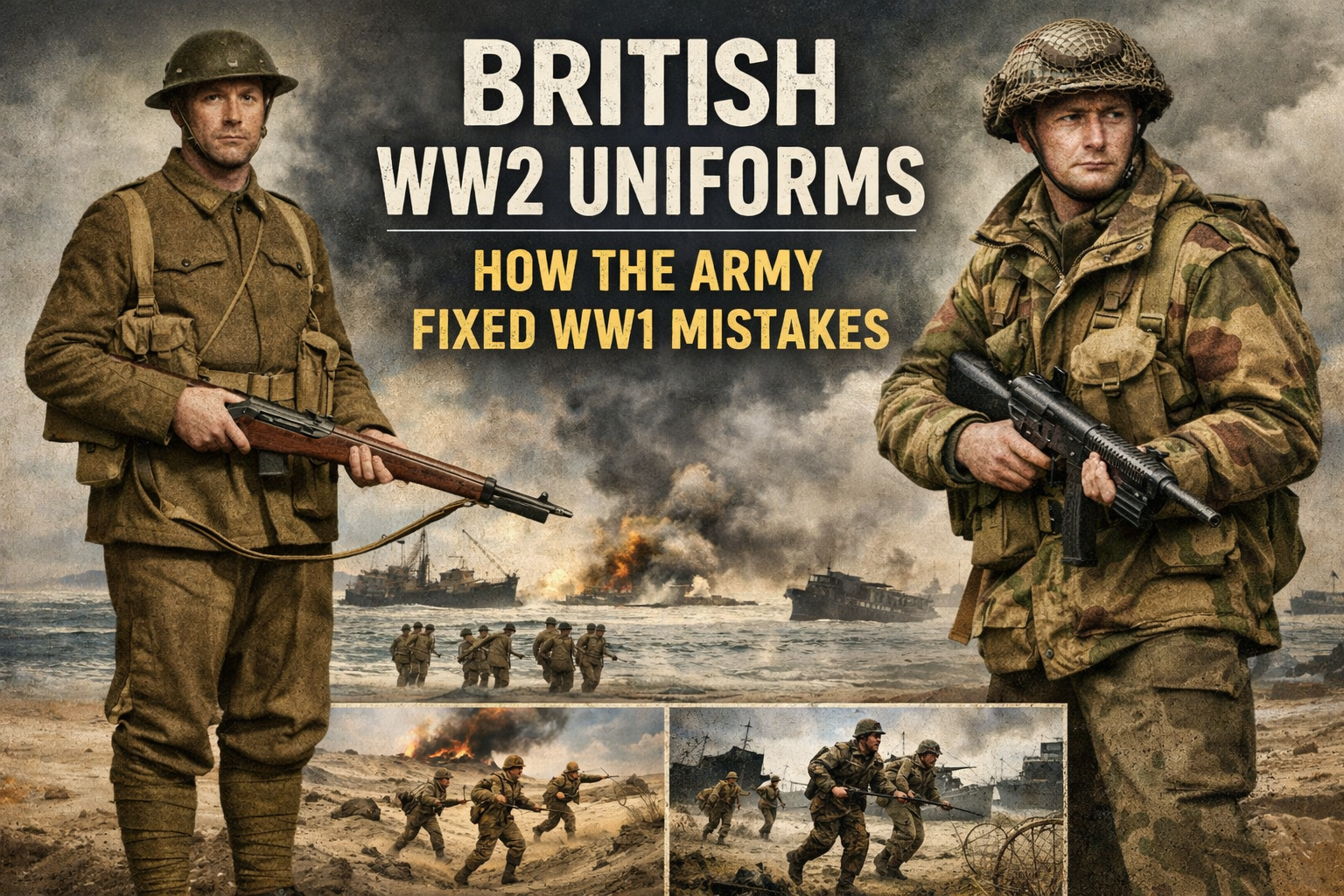
The biggest step was the adoption of the 1937 Pattern Battledress. According to specifications held by the Imperial War Museum, the battledress used wool serge weighing about 18 oz per square yard. It was still wool, but lighter and cut shorter.
Main features that defined British WW2 uniforms included:
-
Short waist-length jackets
-
High-waisted trousers with large map pockets
-
Simplified layering for cold weather
-
Steel helmets shaped for shrapnel protection
-
Role-specific clothing like camo smocks
These changes did not make uniforms perfect, but they made them workable.
Battledress and Helmet Breakdown
The WW2 battledress became the backbone of the British Army uniform. It was worn from North Africa to Northwest Europe.
Battledress key features:
-
Wool serge fabric, 18 oz/yd²
-
Short jacket to reduce snagging
-
Buttoned cuffs for warmth
-
Two chest pockets with pleats
-
Trousers with map pocket on the thigh
The helmet also changed in use, even if the shape stayed similar. The Brodie-style Mk II helmet offered good protection from falling fragments, which were a major cause of injury.
Helmet notes from battle reports:
-
Effective against shell fragments
-
Poor against direct bullet hits
-
Worn low for better coverage after 1941
Camo Smocks for Special Forces
Special units drove innovation faster than regular infantry. Airborne forces and commandos needed gear that worked during drops and raids.
The Denison smock is the best-known example. It used hand-painted camouflage in broad brush strokes. Patterns varied, which helps collectors today.
Denison smock basics:
-
Heavy cotton drill fabric
-
Pullover design worn over battledress
-
Half-zip neck opening
-
Knit cuffs and waist
These smocks were not general issue. They were tied to airborne units, which makes original examples scarce.
Pros and Cons: Data from Battle Reports
British WW2 uniforms had clear strengths and limits. Battle reports from 1941–44 show both.
Pros:
-
Better movement than WW1 dress
-
Short jackets worked well in vehicles
-
Helmets reduced shrapnel wounds
-
Layering allowed some weather control
Cons:
-
Wool still heavy when soaked
-
Limited ventilation in hot climates
-
Buttons and fasteners broke under stress
-
Camo limited to special units
In North Africa, reports noted soldiers cutting sleeves or wearing open jackets due to heat. In Northwest Europe, wet wool was still a problem, but shorter cuts helped troops move through hedgerows.
Real-World Examples from Key Battles
Dunkirk, 1940
Uniforms recovered from Dunkirk often show salt damage and heavy wear. Auction records list standard 1937 battledress blouses with clear provenance selling for $900–$1,400. Many have replaced buttons or field repairs, which match evacuation accounts.
El Alamein, 1942
An 8th Army battledress tunic linked to El Alamein sold in 2024 for about $2,200. The wool showed sun fading, and the original unit patch was intact. Desert use often left lighter wear but more fabric breakdown.
Normandy, 1944
Airborne items dominate this market. A confirmed Denison smock with jump wings sold for over $12,000 at auction. Standard infantry battledress from Normandy typically ranges from $1,500 to $3,000 depending on markings.
For current listings, collectors often check sites like:
https://www.paddelaters.com/ww2-british-uniforms/
FAQs
How can I spot fake British WW2 uniforms?
Check fabric weight, stitching, and buttons. Modern wool feels lighter and smoother.
Are all battledress jackets valuable?
No. Condition, size, and markings matter more than age alone.
What sizes are most collectible?
Smaller sizes often sell higher due to rarity.
Can uniforms be safely worn today?
Yes, but only lightly. Wool weakens with age.
How should I store wool uniforms?
Cool, dry space with acid-free tissue.
Are Denison smocks often faked?
Yes. Hand-painted camo and period stitching are key signs.
Do repairs reduce value?
Field repairs usually add value if original.
Conclusion
British WW2 uniforms show how the army learned from failure. Early war problems rooted in WW1 thinking led to real losses and discomfort. The solution was not fancy design but practical change. Shorter jackets, better pocket layouts, and role-specific gear made a difference.
For collectors, these uniforms are more than cloth. They are records of adaptation under pressure. If you want deeper background, see our earlier post on WW1 British uniforms and compare the designs side by side.
