WW1 GERMAN FIELD GRAY UNIFORMS AND SPIKED HELMETS
Introduction
If you collect, reenact, or just like World War One history, German army WW1 attire always pulls you in. You see rows of gray uniforms and those sharp spiked helmets, and you wonder how it all came to be. Early in the war, German soldiers did not look like the trench fighters you picture today. Many uniforms still showed older ideas. Bright trim. Shiny helmets. Colors that stood out way too much once the shooting started.
This is where the story gets real. The war in 1914 was fast and deadly. Rifles had long range. Artillery ruled the field. Visibility meant life or death. Soldiers wearing outdated colors paid the price. Trench warfare then made things worse. Mud, rain, wire, and constant fire showed every flaw in cloth, cut, and gear.
The solution was not fancy. It was practical. The shift to the WW1 German field gray uniform and changes to the WW1 German spiked helmet saved lives and shaped what we now collect and recreate. In this guide, we break it all down. Clear facts. Simple words. No fluff. Just like you and a friend talking gear at a reenactment camp.
Visibility Problems in 1914
At the start of the war, German army WW1 attire was stuck between old style and new reality. Many units still wore uniforms designed for parade grounds and short battles. These designs failed in open fields and modern combat.
German reports from 1914 show that uniforms were too visible at range. Wool colors varied. Some units still had bright piping. Helmet fittings reflected light. Against enemy rifles firing from hundreds of meters away, this was a problem.
The Imperial feldgrau tunic existed before the war, but use was not fully standard. Some reserve and Landwehr units wore older stocks. Supply limits meant mixed colors in the same unit. This made it easier for enemy observers to spot movement.
Once fighting began in Belgium and France, visibility issues became clear fast. Casualty reports linked losses to exposure during movement. Soldiers could not blend into fields, tree lines, or broken ground. The war was no longer about bold advances. It was about staying unseen.
Bright Colors Fail on the Battlefield
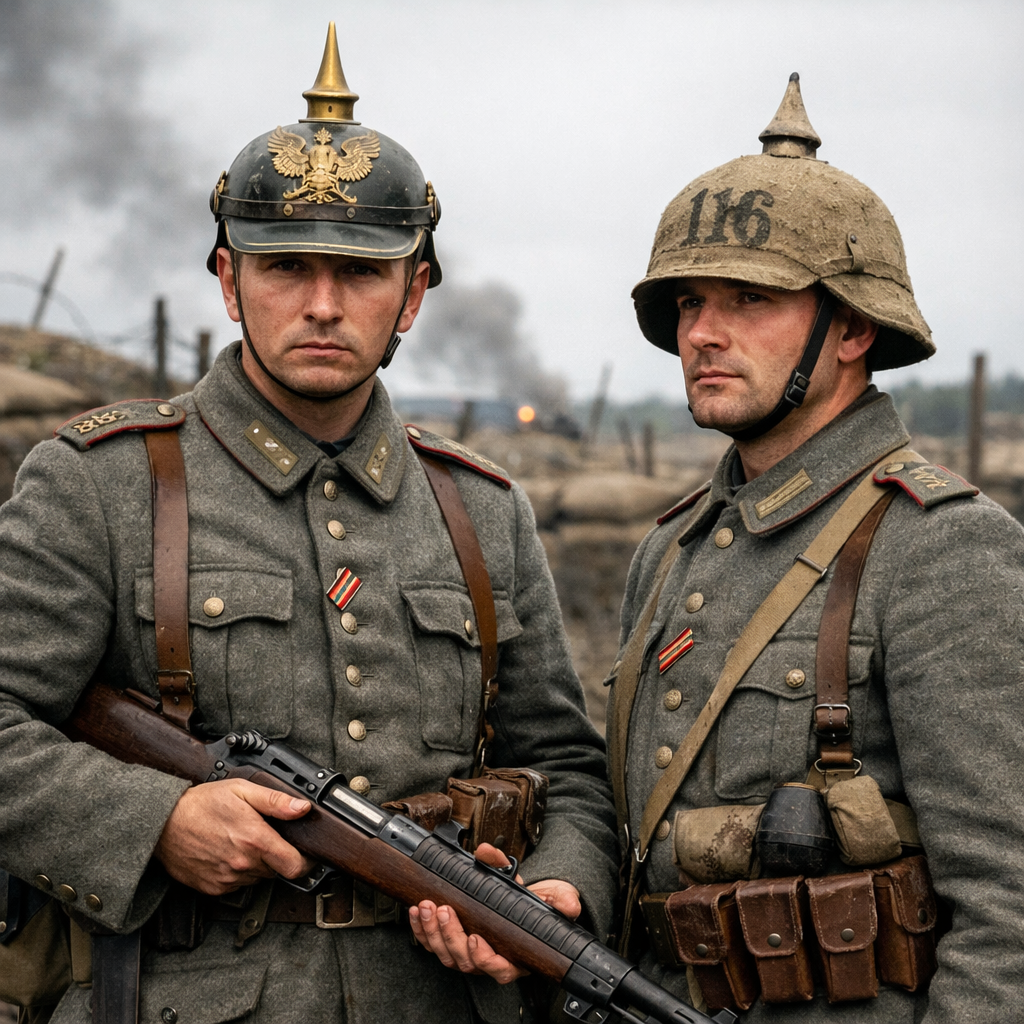
Bright details had a long history in European armies. They showed rank and unit pride. In WW1 German field gray uniform early versions, this tradition still lingered. Red piping. Brass buttons. Shiny helmet spikes.
In daylight, these details caught the eye. Enemy scouts and machine gun crews used them as markers. German after-action reports mention how sun glare on metal fittings gave away positions.
The Pickelhaube helmet was a major issue. Its polished fittings and tall spike stood out against flat land. Soldiers tried to dull them with mud or cloth even before official orders came. It was clear that old habits no longer worked.
Trench Agony Exposed Uniform Flaws
Once trenches formed, German army WW1 attire faced a new test. Life in trenches was harsh. Uniforms stayed wet for days. Wool shrank and stiffened. Seams failed under constant strain.
Imperial German Army supply records from 1915 note rising replacement rates for tunics and trousers. Mud and rot damaged cloth faster than expected. Soldiers complained about tight cuts that limited movement in narrow trenches.
Helmets also struggled. The Pickelhaube helmet was not built for overhead threats. Artillery fragments came from above, not the front. Leather shells offered little protection. Spikes caught on wire and trench walls.
These failures were not minor. They affected survival. Uniform design had to change or losses would continue.
Pickelhaube Vulnerabilities in Combat
The WW1 German spiked helmet looked strong but had weak points. The leather body absorbed water. After weeks in trenches, it softened and lost shape. The spike, once a symbol, became a hazard.
Field reports describe spikes snagging on sandbags and wire. Some units removed spikes on their own. Others covered the entire helmet with cloth to reduce shine and profile.
By late 1915, the limits of the Pickelhaube helmet were clear. While still used, it needed changes. These changes tied closely to the wider shift in WW1 German field gray uniform design.
Field Gray Uniform as the Fix
The solution phase came through standardization and simplification. The WW1 German field gray uniform became the rule, not the exception. Feldgrau dye formulas were tightened to reduce variation. The color blended better with earth and shadow.
Cuts were adjusted. Tunics became looser for movement and layering. Pockets were simplified. Bright trim was removed. Buttons were often dull gray or zinc instead of brass.
Imperial feldgrau tunic production increased fast. German factories produced millions between 1915 and 1917, according to wartime supply summaries. Speed mattered more than looks.
Helmets also evolved. While the Pickelhaube helmet remained in service, covers and changes reduced its drawbacks. By 1916, steel helmets began to replace it at the front, but the spiked helmet still saw use in rear areas.
Specs of WW1 German Field Gray Uniform
A standard WW1 German field gray uniform used wool cloth in muted gray-green tones. Tunics had four front pockets with simple flaps. Collar colors matched the main cloth. Rank was shown with small straps, not bright trim.
Trousers were straight cut and reinforced at stress points. Leather gear shifted to darker finishes. The goal was less shine and longer wear.
The Imperial feldgrau tunic became the visual symbol of German army WW1 attire. When you see photos from 1916 onward, this is the look that dominates.
Pickelhaube Evolution and Covers
To deal with helmet issues, cloth covers were issued. These covered spikes and fittings. Some had unit numbers sewn on early in the war, later removed to reduce visibility.
Spikes were sometimes detachable. Metal fittings were dulled. These changes did not fix protection limits, but they reduced visibility and snagging.
The WW1 German spiked helmet became less about show and more about function, even if its days were numbered.
Pros & Cons Table
Below is a clear look at the strengths and limits of German army WW1 attire during the war.
| Aspect | Pros | Cons |
|---|---|---|
| Field gray color | Reduced visibility | Early dye variation |
| Wool material | Warm, durable | Heavy when wet |
| Imperial feldgrau tunic cut | Better movement | Still tight in trenches |
| Pickelhaube helmet | Lightweight | Poor fragment protection |
| Helmet covers | Lower visibility | Limited impact safety |
| Standardization | Easier supply | Slower early adoption |
This balance shows why changes kept coming as the war dragged on.
Real-World Examples
Soldiers at the Somme in 1916 show the shift clearly. Photos reveal nearly universal use of the WW1 German field gray uniform. Helmet covers are common. Bright trim is gone.
Modern reenactors see the same lessons. Groups using early-war kits note how visible older styles look in open fields. Many switch to later feldgrau patterns for accuracy and realism.
Collectors also track these changes. Early Imperial feldgrau tunic examples with bright piping are rarer. Later plain versions appear in larger numbers, matching production records.
FAQs
How can I spot an authentic WW1 German field gray uniform?
Check cloth weight, stitching, and button material.
Are Pickelhaube helmets safe to wear today?
Only for display or reenactment, not protection.
Did all units switch to feldgrau at once?
No. Supply delays caused overlap.
Why are helmet covers important?
They reduce shine and outline.
Are replicas accurate today?
Good replicas match wartime specs closely.
Conclusion
German army WW1 attire shows how fast armies had to learn. Bright colors failed. Trenches punished weak designs. The answer was the WW1 German field gray uniform and adapted Pickelhaube helmet use. For collectors and reenactors, these changes matter. They tell the real story behind the gear.
If you want accurate replicas that respect this history, explore the WW1 uniforms and helmets at paddelaters.com. Build a kit that matches the facts, not the myths.
