Introduction
You grab that Legion replica, but does it match the real deal? Many collectors face this problem. Photos online look fine. The price feels right. Then the box arrives. The fabric is off. The kepi shape looks wrong. The shade of blue does not match WWI records. Now you are stuck with a piece that does not line up with history.
This happens a lot with French Foreign Legion uniform replicas and WWI French soldier uniforms. Sellers mix details from different eras. Some use bright blue cloth instead of proper horizon blue. Others copy the Legion kepi but miss the correct cut or white cover rule adopted after 1946. Small errors add up. If you collect for display, reenactment, or film, those errors matter.
The good news? You can avoid these mistakes. When you know the facts, you shop smarter. In this guide, we break down Legion basics, WWI French army uniform replica details, and buying tips. Think of this as collector talk. Straight facts. No hype. Let’s connect the Legion story to its WWI roots and help you spot the right replica.
Legion Uniform Basics
The French Foreign Legion is part of the French Army. Its identity grew from service in North Africa during the 19th century. Over time, the Legion built strong symbols. These symbols show up in replicas today.
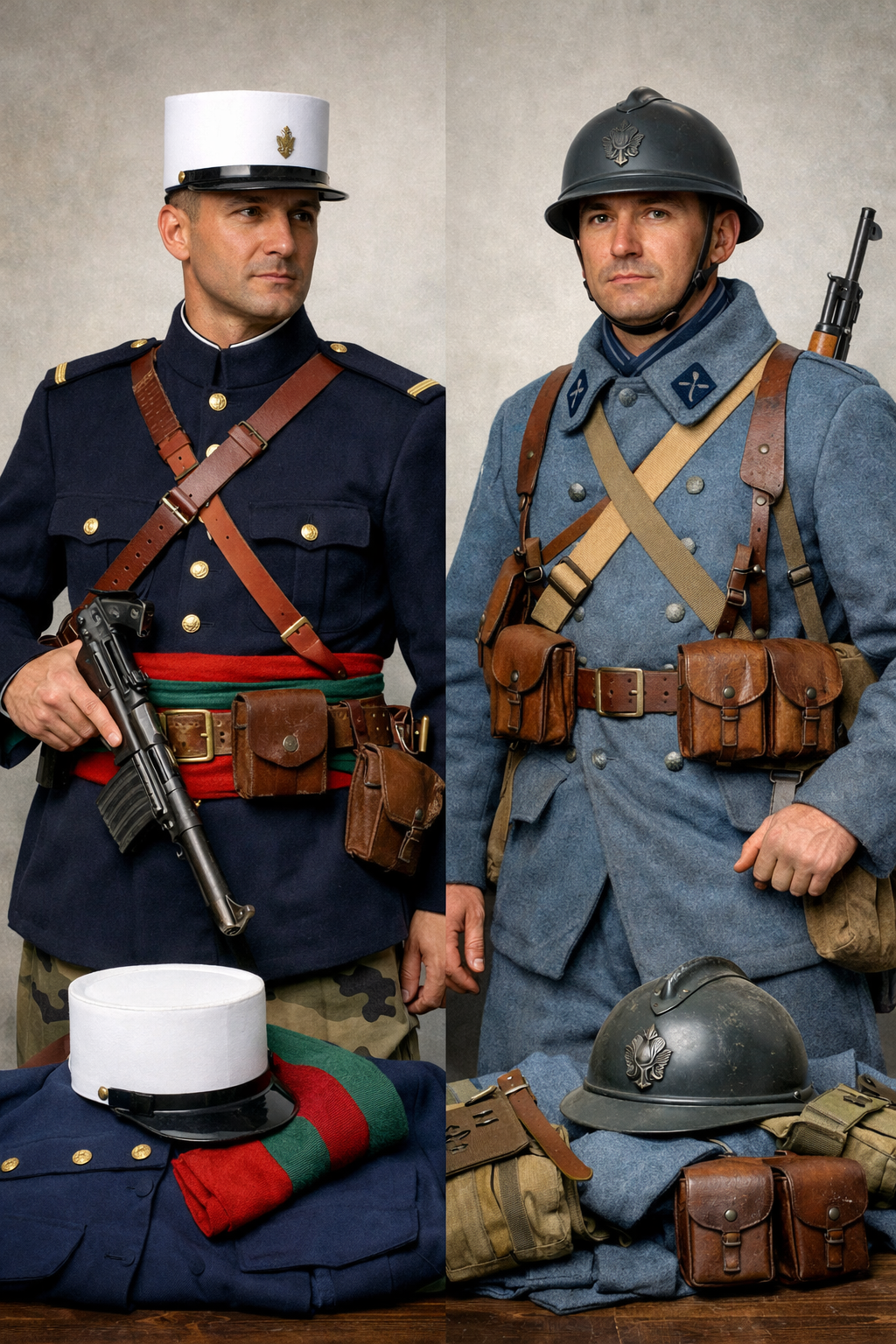
The most recognized item is the white kepi. Since 1946, Legion soldiers have worn a white kepi cover in garrison dress. Before that, the kepi could be red or dark blue depending on era. Modern Legion parade dress often includes a dark blue uniform, white kepi, and green and red sash.
Field gear changed with time. In the late 20th century, Legion troops used standard French F1 combat uniforms. These included camouflage jackets, cargo trousers, and combat boots. The Legion follows French Army equipment rules. So a modern Legion uniform replica should match French Army issue gear for that period.
Collectors often look for:
-
Parade dress uniform
-
Kepi blanc
-
Sash
-
Field uniform from Indochina or Algeria
-
Modern F1 combat gear
Each era has clear specs. When a seller mixes parts from different decades, that is a red flag.
Iconic Kepi and Sash Facts
Let’s talk about the kepi. The Legion kepi blanc is white in garrison use since 1946. It has a flat circular top and a short visor. The band color and insignia depend on unit and rank. Officers may have gold braid details. Enlisted ranks are simpler.
The green and red sash wraps around the waist. It reflects Legion tradition from North Africa. The colors are not random. They link to long service and sacrifice.
When buying a Legion kepi replica, check:
-
Shape: Is the crown flat and correct height?
-
Color: Is the white bright but not glossy?
-
Visor: Short and firm, not oversized
-
Insignia: Does it match the unit and era?
If the sash is included, check stitching and color balance. Faded or incorrect shades show poor research.
WWI French Soldier Uniform Replica Guide
Now let’s connect the Legion to World War I. During WWI, the French Army wore horizon blue uniforms. This replaced the earlier red trousers and dark blue coats in 1915. Horizon blue was meant to reduce visibility on the battlefield.
The French Foreign Legion fought in WWI under French command. So Legion troops also wore standard French Army uniforms in that period. That is the key link. If you collect a WWI French soldier uniform, you are also touching Legion history.
A proper WWI French army uniform replica includes:
-
Horizon blue tunic
-
Matching trousers
-
Leather belt and equipment
-
Adrian helmet, introduced in 1915
Many collectors browse WWI uniforms to compare cuts and materials. The tunic design matters. Early war coats were long. Later versions became more practical.
If a seller claims “WWI style” but uses bright royal blue cloth, that is wrong. Horizon blue is a muted grey-blue tone. It should not look modern or shiny.
Horizon Blue Fabric and Helmet Details
Horizon blue was a mix of blue, white, and red wool fibers. The result was a soft blue-grey shade. Fabric weight was heavy wool. It was built for trench conditions.
A correct WWI French soldier uniform replica should use wool or wool blend with:
-
Matte finish
-
Medium to heavy weight
-
Proper pocket placement
-
Stand collar with correct insignia tabs
The Adrian helmet is also key. Introduced in 1915, it has:
-
Distinct front badge
-
Ridge along the top
-
Four main parts assembled with rivets
If the helmet badge is missing or wrong, the replica loses value. Some replicas skip interior lining details. That affects comfort and realism.
When comparing Legion and WWI gear, remember: WWI uniforms were practical war gear. Modern Legion parade dress is ceremonial. Different purposes. Different specs.
Features and Specs
Here is how Legion replicas and WWI French army uniform replicas compare in simple terms:
-
Legion parade uniform: Dark blue coat, white kepi, green-red sash, leather belt.
-
Legion field uniform (modern F1): Camouflage pattern, cargo pockets, combat boots.
-
WWI French soldier uniform: Horizon blue wool tunic and trousers, Adrian helmet.
If you collect both, you cover two eras. Some collectors even build displays linking a Legion soldier in WWI next to a modern Legionnaire.
You can explore related French sets under French uniforms and compare details with other European pieces in military replicas.
Pros & Cons
| Feature | Legion Replicas | WWI French Replicas |
|---|---|---|
| Cost | Often mid to high, depends on dress or field set | Varies, wool sets can cost more |
| Durability | Modern F1 gear is strong; parade dress is lighter | Wool durable but heavy |
| Authenticity Risk | Kepi shape errors common | Color mistakes common |
| Comfort | Parade dress lighter; field gear practical | Heavy wool in warm weather |
| Display Value | High due to white kepi symbol | Strong due to WWI history |
Both types have value. But both require research before buying.
Real-World Examples
Think about the Legion in Indochina during the 1950s. Soldiers wore field gear suited to jungle warfare. Uniforms included lightweight shirts, shorts or trousers, and headgear adapted to climate. A replica claiming “Indochina Legion” but using modern European camouflage would be inaccurate.
Now look at WWI. A French soldier at Verdun in 1916 would wear horizon blue and an Adrian helmet. Equipment included leather pouches and rifle gear. If your replica has plastic buttons or thin costume fabric, it will not match that setting.
Some collectors build paired displays. One side shows a WWI French soldier uniform replica. The other shows a post-1946 Legionnaire in white kepi. That visual link shows continuity of service under the French flag.
When buying for reenactment, small details matter more. Stitch lines, pocket angles, and button style all count. For display, fabric tone and silhouette matter most.
FAQs
1. How to tell real French Foreign Legion uniform replica quality?
Check kepi shape, sash color, and fabric weight. Compare with historical photos.
2. What is horizon blue?
A grey-blue shade used by the French Army from 1915 in WWI.
3. Did the Legion wear horizon blue in WWI?
Yes. Legion units followed French Army uniform rules during the war.
4. Is the white kepi always worn?
It is worn in garrison dress since 1946. Field gear may differ.
5. Are wool WWI replicas good for reenactment?
Yes, if fabric weight and color are correct. But they can feel heavy in heat.
Conclusion
Collecting French Foreign Legion uniforms and WWI French soldier replicas takes patience. You want pieces that match history, not costume shortcuts. Focus on facts. White kepi since 1946 for Legion garrison. Horizon blue from 1915 for WWI French troops. Adrian helmet with correct badge. Proper wool weight. Correct sash colors.
When you shop with these checks in mind, you avoid wasted money. You also build a collection that tells a real story. The Legion’s service in WWI links both worlds. Parade dress today reflects long tradition. Horizon blue reminds us of trench warfare and change.
Before you click buy, compare specs. Look at fabric. Study photos. Then explore paddelaters.com for researched sets that align with historical records. Build your display with confidence, not guesswork.
